
Awesome Bug Bounty Tools: Top Security Research Toolkit

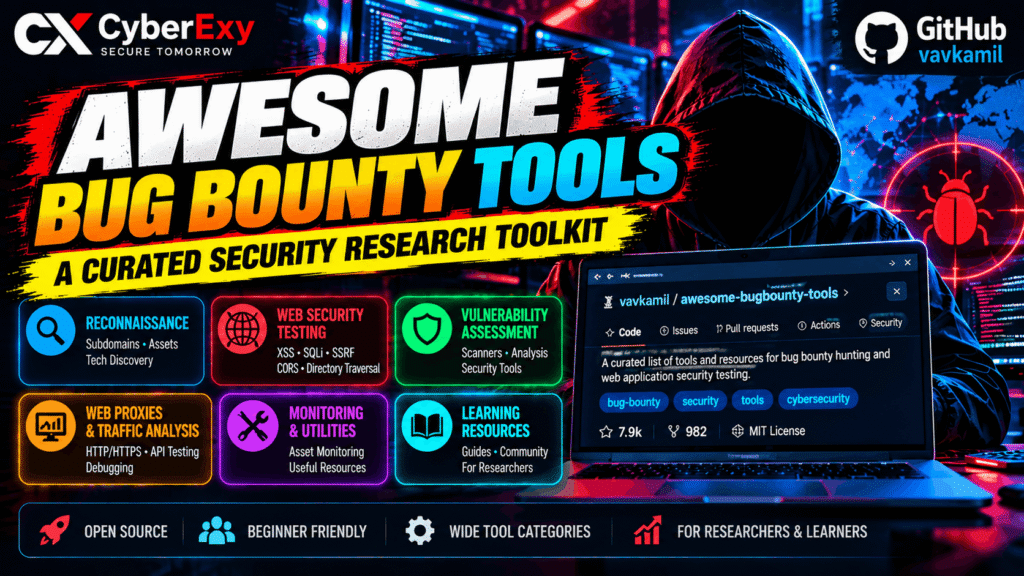
Awesome Bug Bounty Tools: A Curated Security Research Toolkit
Discover the Awesome Bug Bounty Tools GitHub repository by Vavkamil, a curated collection of resources for web application security testing, reconnaissance, vulnerability assessment, and responsible security research.
Bug bounty hunting has become an important part of modern cybersecurity, helping organisations identify security weaknesses before malicious actors can exploit them. However, learning which tools to use and understanding their different purposes can be challenging for beginners and experienced researchers alike.
The Awesome Bug Bounty Tools repository brings many security-testing resources together in one place. Available on GitHub, this community-oriented collection helps researchers explore tools for different stages of web application security assessments.
🔗 Official repository: https://github.com/vavkamil/awesome-bugbounty-tools
What Is Awesome Bug Bounty Tools?
Created by Vavkamil, Awesome Bug Bounty Tools is a curated list of tools and resources associated with bug bounty hunting and web security testing. Rather than being a single application, it acts as a directory that organises resources into categories.
The repository covers reconnaissance, subdomain enumeration, technology identification, content discovery, vulnerability assessment, and numerous web application security topics. It also includes resources relating to monitoring, web proxies, and other specialised testing areas.
For learners, this organisation provides a useful starting point for understanding the broader security research ecosystem.
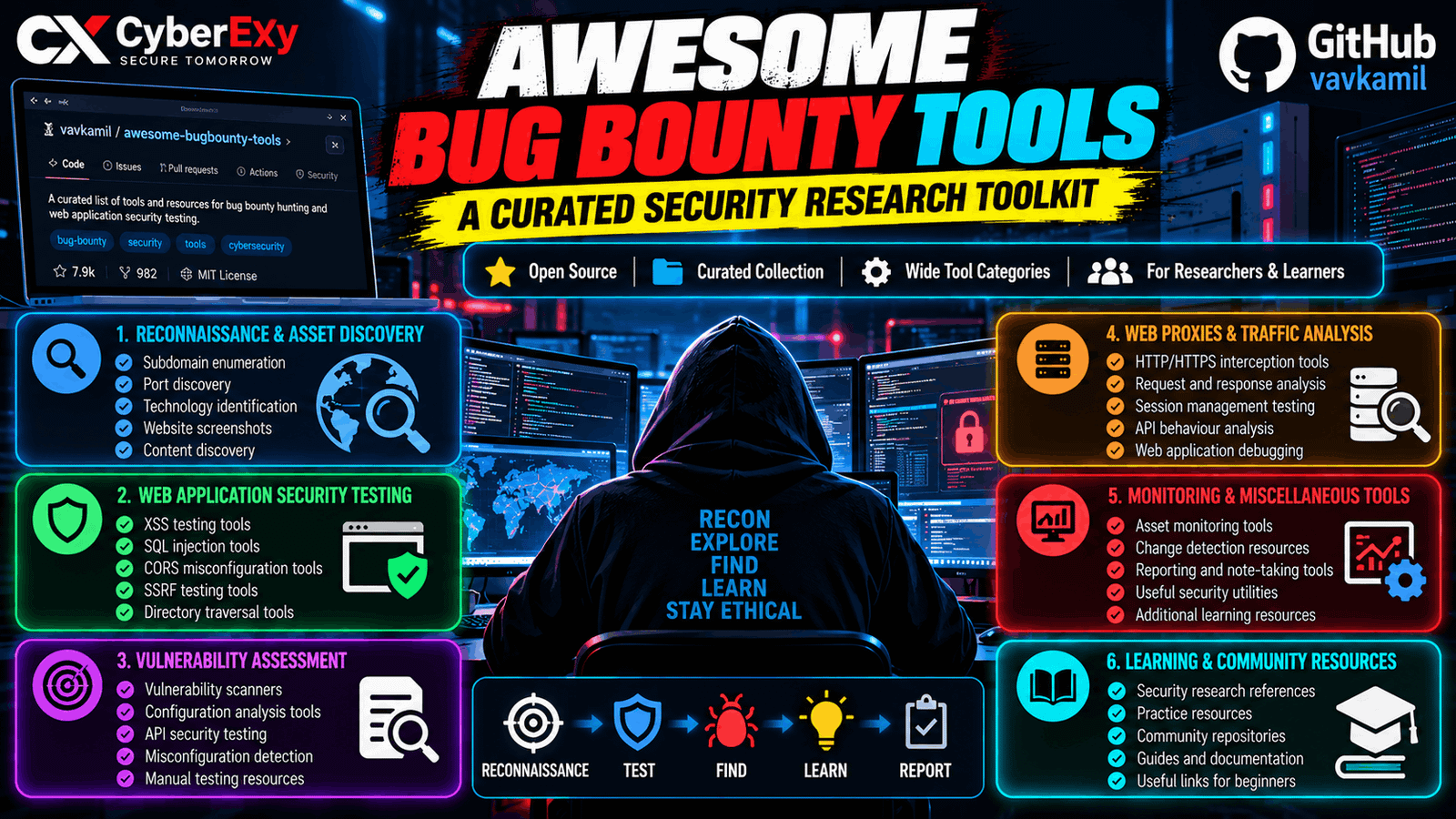
Key Categories Covered in the Repository
1. Reconnaissance and Asset Discovery
Reconnaissance helps researchers understand the systems and technologies within an authorised assessment’s scope. The repository includes resources for subdomain enumeration, port discovery, technology identification, website screenshots, and content discovery.
These categories can help security professionals build an inventory of approved assets and understand the visible components of a web application.
2. Web Application Security Testing
Web applications may contain weaknesses involving authentication, access control, input validation, configuration, or data handling.
The repository groups resources related to security issues such as cross-site scripting (XSS), SQL injection, cross-origin resource sharing (CORS) misconfigurations, server-side request forgery (SSRF), and directory traversal.
Understanding these vulnerability classes helps developers and security researchers recognise potential risks and evaluate appropriate defensive controls.
3. Vulnerability Assessment Resources
The collection includes references to vulnerability scanners and broader security-testing frameworks. These resources can support authorised assessments by helping researchers identify potential weaknesses that require further investigation.
Automated findings should never be treated as proof of a vulnerability without validation. False positives, outdated signatures, and differences between testing environments can affect results.
4. Web Proxies and Traffic Analysis
Web proxies allow security professionals to inspect HTTP requests and responses, understand application behaviour, and investigate how applications process user input.
The repository includes a dedicated category for web proxies and traffic interception. These resources are particularly relevant when studying API behaviour, session management, and application security controls in an approved test environment.
5. Monitoring and Supporting Resources
Security assessments often involve more than running a scanner. Researchers may also need to organise discovered assets, monitor relevant changes, review documentation, and maintain clear records of their findings.
The repository includes resources for monitoring and miscellaneous security tasks, helping researchers discover tools suited to different assessment requirements.
Who Should Explore This Repository?
Awesome Bug Bounty Tools may be useful for:
- Cybersecurity students learning about web application security.
- Bug bounty beginners exploring the different stages of security research.
- Penetration testers researching tools for authorised assessments.
- Security engineers investigating application weaknesses and defensive testing approaches.
- Developers learning about common web vulnerabilities and testing methods.
Beginners should focus on understanding HTTP, DNS, authentication, access control, and common web vulnerabilities before attempting complex assessments.
How to Use the Repository Responsibly
Start by reviewing the repository’s README and selecting a category relevant to your learning objectives. Read the documentation for individual projects before installing or using any tool.
Practise in intentionally vulnerable training applications, local test environments, or programmes that explicitly authorise your activities. Always follow the programme’s scope, rate limits, and testing rules. Do not scan or test systems without permission.
Also remember that a listing in a curated repository does not guarantee that a tool is maintained, secure, or suitable for every environment. Check its current status, dependencies, licence, and documentation.
Final Thoughts
The Awesome Bug Bounty Tools repository is a valuable reference for exploring the tools and concepts used in web application security research. Its organised categories make it easier to discover resources for reconnaissance, vulnerability assessment, traffic analysis, and other testing activities.
Rather than collecting tools without a plan, use the repository to build a structured learning path, understand the purpose of each resource, and develop responsible security-testing skills.
Explore the repository: https://github.com/vavkamil/awesome-bugbounty-tools
Follow CyberExy for more cybersecurity guides, security research resources, and practical learning articles.
Disclaimer: This article is for educational purposes. Perform security testing only on systems you own or have explicit permission to assess.