Hackers Target South Korean Banks Using AI Tools

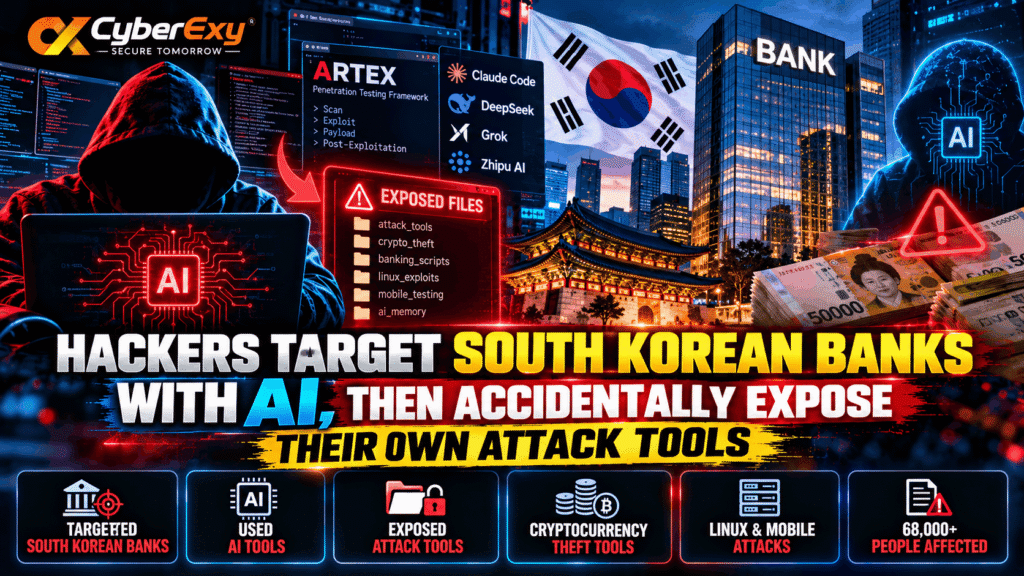
Hackers Target South Korean Banks With AI, Then Accidentally Expose Their Own Attack Tools
October 20, 2026 — Hackers linked to AI-assisted attacks against South Korean financial institutions accidentally exposed parts of their own infrastructure, allowing researchers to uncover attack tools, testing activity, and preparations that began weeks before the banking incidents became public.
Researchers from Recorded Future’s Insikt Group identified the activity associated with a threat actor tracked as TAG-217. Their October 16 report described a broader operation involving cryptocurrency-related tools, Linux system attacks, and mobile security testing, extending beyond the reported banking campaign.
Public reporting indicated that the breaches exposed personal information belonging to approximately 68,000 people across at least seven financial institutions. The incidents involved different systems and data types rather than one identical breach affecting every organization. <Cite refs={[“turn246485search1″,”turn246485news18”]}/>
AI-Assisted Attacks Target South Korean Banks
The investigation highlights how attackers can combine artificial intelligence with existing penetration-testing tools to explore potential weaknesses across multiple environments.
The campaign involved ARTEX, an open-source, AI-enabled penetration-testing framework designed for security assessment. Although tools of this kind can support legitimate defensive testing, they can also be misused to identify and exploit weaknesses without authorization.
Earlier reporting described the use of AI-assisted workflows involving Claude Code and other AI models. Researchers associated the broader activity with tools including DeepSeek, Grok, and Zhipu AI. Investigators suspected a Chinese-speaking operator, but language clues alone do not establish nationality or government sponsorship. <Cite refs={[“turn246485search0″,”turn246485search1”]}/>
The incidents also demonstrated why financial institutions must protect supporting business systems, not just their core banking platforms. Loan-related applications, employee-support systems, and other connected services may contain sensitive customer or employee information.
Exposed Infrastructure Reveals Earlier Preparations
According to Recorded Future, exposed directories and operational records allowed researchers to reconstruct activity dating back to August 2026.
Between August 17 and August 22, TAG-217 tested infrastructure associated with remote access and scanned internet-facing systems. The observed connections between the actor’s own servers did not establish successful access to victims during that period.
Researchers subsequently identified tools associated with cryptocurrency mining environments, including capabilities designed to search for wallet-related files, attempt authentication, and maintain remote access.
Later records showed experiments involving Linux systems and mobile-device security. By late September, the exposed workspace also contained activity related to target research, traffic routing, and payload preparation.
These findings reveal a broader set of capabilities than those associated with the banking incidents alone. However, evidence that a tool was developed or tested does not prove it was successfully deployed against every potential target. <Cite refs={[“turn246485search1”]}/>
How AI Fits Into the Cybersecurity Threat
AI-assisted development can help operators research unfamiliar technologies, organize workflows, and adapt existing tools. When combined with automated testing frameworks, these capabilities may allow an individual to investigate more systems with less manual effort.
Nevertheless, the exposed files do not establish exactly how much AI accelerated the campaign or demonstrate that an autonomous agent independently completed every intrusion.
The incident also illustrates a basic operational security failure: the attackers left parts of their own working environment accessible. Researchers could examine the exposed material and identify activity that might otherwise have remained unknown.
For defenders, this creates an opportunity to learn from the attackers’ mistakes without assuming that every observed capability resulted in a successful compromise.
What Organizations Should Do
Financial institutions and other organizations should review internet-facing applications, partner portals, employee systems, and third-party services for weaknesses in authentication and access control.
Security teams should monitor unusual sign-in patterns, excessive customer-record requests, unexpected remote-access activity, and abnormal data transfers. They should also restrict access to sensitive records according to job responsibilities and investigate systems that expose internal files or operational information publicly.
Incident-response plans should include procedures for identifying affected systems, preserving relevant evidence, limiting unauthorized access, and communicating confirmed findings accurately.
Indicators of Compromise (IoCs)
Recorded Future’s public report does not provide a complete set of directly usable indicators in the supplied material. The available information does not establish specific hashes, IP addresses, or malicious domains that can be reproduced reliably here.
Security teams should obtain verified indicators from trusted threat-intelligence sources and validate them before adding detection rules. They should avoid treating unconfirmed infrastructure as malicious solely because it resembles an indicator described in secondary reporting.
Conclusion
The South Korean banking incidents demonstrate how AI-assisted tools can support broader cyber operations while ordinary security mistakes can expose an attacker’s own infrastructure. The most important defensive lesson is to secure connected business applications, restrict access to sensitive information, and monitor suspicious activity across the entire technology environment.
As AI-assisted attack techniques evolve, strong access controls, timely remediation, and evidence-based incident response remain essential.