
ScarlettGroup: New Cyber Extortion Gang Threatens Data Leaks

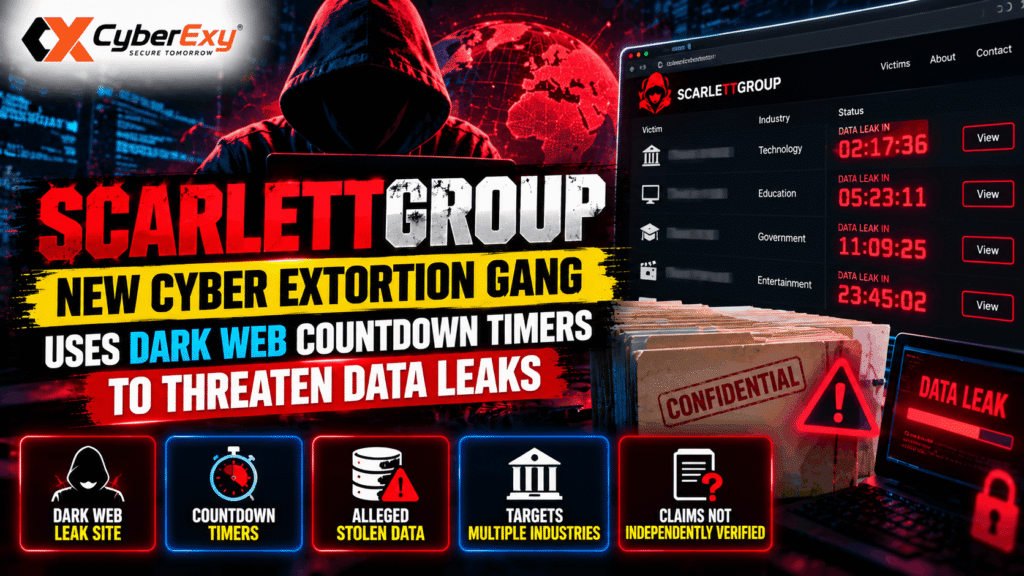
ScarlettGroup: New Cyber Extortion Gang Uses Dark Web Countdown Timers to Threaten Data Leaks
A newly observed cyber extortion group known as ScarlettGroup is reportedly using a dark web leak site to name organizations, advertise allegedly stolen data, and display countdown timers threatening public disclosure.
The operation creates pressure on organizations before the underlying breach claims have necessarily been independently verified. According to threat intelligence research published by Foresiet on October 21, 2026, ScarlettGroup began appearing in monitoring records around September and became more visible during October.
Its reported listings span several sectors, including technology, education, government, and entertainment. However, researchers have not established a clear industry focus, confirmed the total number of affected organizations, or independently verified the full extent of the group’s activities.
The available findings point to an emerging data extortion operation, rather than a confirmed ransomware family. Investigators have not established how ScarlettGroup gains initial access, whether it deploys file-encrypting malware, or what technical methods it uses during intrusions.

Source: Foresiet’s ScarlettGroup threat intelligence report.
How ScarlettGroup Uses Dark Web Leak Listings
ScarlettGroup reportedly operates a Tor-based leak site where alleged victims appear alongside publication dates, industry classifications, disclosure statuses, and countdown timers.
These listings create a visible deadline for organizations named by the group. The apparent objective is to pressure targeted companies into contacting the operators before the advertised disclosure deadline expires.
This approach reflects a broader extortion tactic in which threat actors use public allegations and threatened data publication to increase pressure on potential victims. A countdown timer can intensify reputational concerns, operational uncertainty, and pressure from customers or business partners.
However, a listing alone does not prove that the organization suffered a breach. The advertised records may be genuine, misrepresented, outdated, incomplete, or unrelated to the named organization. Each claim requires independent investigation.
The tactic resembles other reported cases involving criminal leak sites, including allegations surrounding an incident involving BMW and the Everest group. This is a comparison of extortion tactics only; it does not establish a connection between Everest and ScarlettGroup.
ScarlettGroup’s Reported Extortion Process
According to Foresiet’s analysis, ScarlettGroup presents an apparent process involving three stages:
1. Public victim listing
An organization is named on the leak site, accompanied by information intended to support the group’s claim that it possesses the organization’s data.
The listing can attract attention before investigators have determined whether the advertised material is authentic or whether unauthorized access actually occurred.
2. Negotiation window
The group provides a period during which the named organization can reportedly communicate with its operators.
This stage places the organization under pressure to assess the allegation, investigate potential exposure, and make decisions while facing a public deadline.
3. Closure or alleged data disclosure
ScarlettGroup reportedly claims that reaching a settlement will result in the removal of the listing and deletion of the data. If negotiations fail, the group threatens to publish the information.
These statements are claims made by the operators, not independently verified guarantees.
Removing a listing does not prove that stolen data has been deleted. Copies may remain elsewhere, and a settlement does not establish that any unauthorized access has stopped. Organizations must independently investigate the incident and verify the security of their systems.
What Researchers Have Observed So Far
Foresiet documented ScarlettGroup-related activity on PwnForums, including alleged breach announcements and data offerings. Reported associations with BreachForums and DarkForums require additional verification.
Criminal forums can amplify allegations beyond the original leak site. They may also provide investigators with leads that can be compared against internal security telemetry, exposed records, and other independent evidence.
At present, the publicly described findings do not establish a confirmed victim count or a complete picture of the group’s technical operations.
The report does not identify a verified exploited vulnerability, a confirmed malware payload, or an established initial-access method. It also does not demonstrate that ScarlettGroup encrypts victims’ files.
These gaps matter because data extortion and ransomware are related but distinct concepts. A group can threaten to disclose information without necessarily encrypting systems. Until stronger technical evidence emerges, describing ScarlettGroup as a confirmed ransomware operation would go beyond the documented findings.
Why Countdown-Based Data Extortion Matters
Countdown-based leak sites can create urgency even when the underlying claims remain unverified. Organizations may face questions from customers, employees, suppliers, regulators, and other stakeholders while trying to determine whether an incident occurred.
The public deadline can complicate decision-making by creating pressure to respond before the technical investigation is complete.
Three risks deserve particular attention:
- Reputational pressure: Public allegations may damage trust before the facts are established.
- Potential data exposure: If the advertised records are authentic, their disclosure could create privacy, legal, and operational consequences.
- Investigation challenges: Security teams must separate credible evidence from criminal claims while preserving information that may support an investigation.
The appropriate response is not to assume that every listing represents a confirmed breach or to dismiss every allegation as fabricated. Instead, organizations should assess the evidence and investigate proportionately.
How Organizations Can Respond to a ScarlettGroup Claim
Organizations named on a criminal leak site should coordinate their security, legal, privacy, and incident-response teams. The immediate objective is to establish whether unauthorized access occurred, identify potentially affected information, and determine whether the activity is ongoing.
Verify the allegation
Compare the criminal group’s claims with internal security logs, identity-provider records, endpoint telemetry, cloud audit trails, and available data-loss monitoring alerts.
If the group publishes sample records, assess their authenticity and sensitivity without unnecessarily distributing potentially exposed personal or confidential information.
Preserve forensic evidence
Retain relevant logs, alerts, suspicious files, access records, and copies of publicly visible claims according to the organization’s incident-response procedures.
Preserving evidence can help investigators establish a timeline, assess the scope of possible access, and support subsequent reporting or legal action.
Review account and access security
Check for suspicious authentication events, compromised credentials, unexpected privilege changes, unfamiliar sessions, and unusual access to sensitive repositories.
Enforce multifactor authentication, review privileged accounts, revoke unauthorized sessions, and rotate affected credentials when warranted by the investigation.
Investigate unusual data transfers
Review network, endpoint, cloud, and application telemetry for unexpected downloads, bulk exports, unusual outbound transfers, or access patterns inconsistent with normal business activity.
These indicators are general defensive investigation priorities. They are not confirmed ScarlettGroup-specific indicators of compromise.
Prepare communications and reporting
Follow applicable incident-response, contractual, regulatory, and data-protection requirements. Keep public statements evidence-based, distinguish confirmed facts from allegations, and avoid making promises about data deletion that cannot be verified.
Organizations may also monitor relevant threat intelligence sources for additional claims, but underground-source information should be corroborated before being treated as established fact.
ScarlettGroup Indicators of Compromise (IoCs)
The available Foresiet findings described in this report do not provide a verified technical IoC set that defenders can reliably use to identify ScarlettGroup activity within their networks.
| Indicator category | Available information |
|---|---|
| Threat actor name | ScarlettGroup |
| File hashes | Not published in the supplied findings |
| Malware filenames or samples | Not established |
| IP addresses | Not published |
| Domains | No verified domain IoCs provided |
| Tor leak site address | Not provided in the supplied material |
| Forum activity | PwnForums activity documented by Foresiet; other reported associations require verification |
| Confirmed initial-access method | Not established |
| Confirmed ransomware encryption | Not established |
Security teams should avoid treating the absence of published IoCs as evidence that their networks are unaffected. Behavioral monitoring, identity security, data-access auditing, and incident investigation remain important even when no actor-specific indicators are available.
ScarlettGroup: What We Know and What Remains Unclear
Foresiet’s October 21, 2026 report documents an emerging extortion operation centered on public victim listings and threats of data disclosure. The reported use of countdown timers illustrates how criminal operators can apply pressure without publicly demonstrating a conventional ransomware deployment.
Important questions remain unanswered. Researchers have not established the group’s initial-access methods, confirmed its complete victim list, or demonstrated the full extent of its operations. Its claims about deleting data after a settlement also remain unverified.
For defenders, the central lesson is straightforward: a dark web countdown is a threat claim, not forensic proof of a breach.
Organizations should investigate credible allegations promptly, preserve relevant evidence, review access and data-transfer activity, and communicate based on verified findings. As further intelligence becomes available, independent corroboration will be essential to understanding ScarlettGroup’s capabilities and assessing the real impact of its operations.
Sources
- Foresiet — ScarlettGroup Data Extortion: Threat Intelligence Research
- Cybersecurity News — Report on the alleged BMW breach involving Everest
CyberExy will continue to distinguish reported threat activity from independently confirmed incidents as additional evidence becomes available.