Microsoft Offers $40,000 for Complete Azure Bug Reports

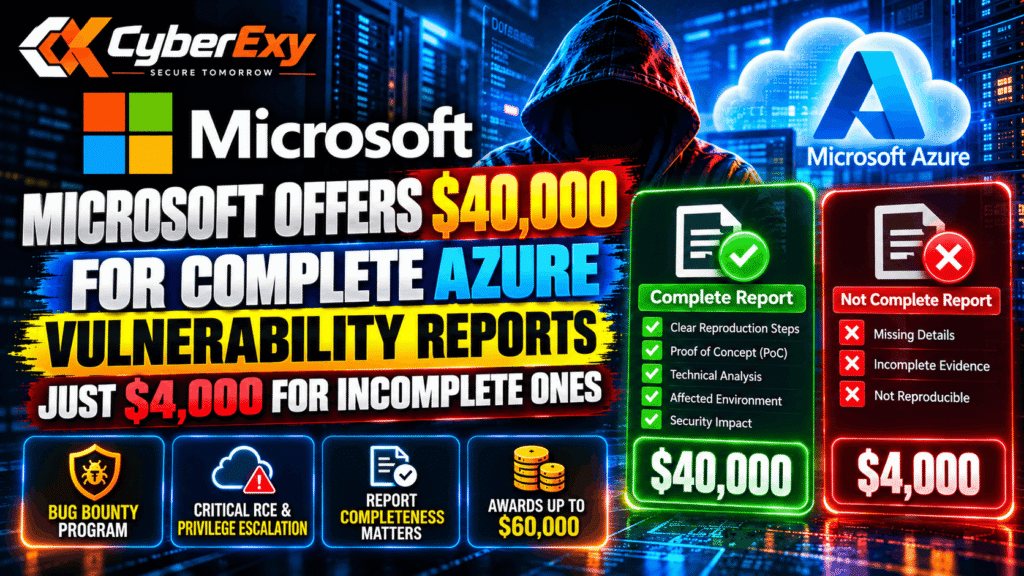
Microsoft Offers $40,000 for Complete Azure Vulnerability Reports, Just $4,000 for Incomplete Ones
Microsoft has introduced a new vulnerability report assessment system across its bug bounty programs, making report quality a major factor in determining rewards for security researchers. Under the Azure Bounty Program, eligible critical remote code execution (RCE) and privilege escalation reports can receive $40,000 when marked Complete, compared with just $4,000 when assessed as Not Complete.
The new policy applies to eligible reports submitted from October 20, 2026, at 8:00 AM Pacific Time. Submissions made before the deadline remain subject to Microsoft’s previous report quality requirements.
According to Microsoft, the change is designed to reduce follow-up requests for missing information, improve vulnerability reproduction, and help security engineers assess reported security flaws more efficiently.
Microsoft Introduces New Azure Bug Bounty Report Requirements
Microsoft’s updated assessment framework introduces two report quality classifications: Complete and Not Complete. These classifications evaluate whether a submission contains sufficient technical evidence for Microsoft engineers to reproduce and assess a reported vulnerability.
A Complete report provides the essential technical information, reproduction steps, and supporting evidence required to understand the security issue. A Not Complete report lacks one or more necessary details, files, or explanations.
The distinction has a substantial financial impact. Under the published Azure bounty structure, eligible critical vulnerabilities can receive significantly lower rewards when reports fail to meet the completeness requirements.
However, report completeness does not automatically determine vulnerability severity or guarantee a bounty payment. Microsoft evaluates the security impact, severity, eligibility, and program requirements separately.
Azure Vulnerability Bounty Rewards: Complete vs. Incomplete Reports
Microsoft’s published reward structure demonstrates how report completeness can affect eligible bounty payments.
| Vulnerability category | Complete report | Incomplete report |
|---|---|---|
| Critical remote code execution | $40,000 | $4,000 |
| Critical privilege escalation | $40,000 | $4,000 |
| Critical information disclosure | $12,000 | $1,200 |
| Critical spoofing | $8,000 | $800 |
| Critical tampering | $8,000 | $800 |
| Important remote code execution | $30,000 | $3,000 |
Note: These figures apply to the relevant eligible vulnerability categories and report assessments. They are not guaranteed payments for every submission.
The Azure Bounty Program lists a general award range of $400 to $60,000, with additional rewards potentially available at Microsoft’s discretion. Certain high-impact scenarios may also qualify for increased awards under the applicable program rules.
What Makes an Azure Vulnerability Report Complete?
Security researchers must provide enough information for an engineer who is unfamiliar with the discovery to reproduce and evaluate the vulnerability using the initial submission.
A strong report should include:
- Clear reproduction steps: Explain each step needed to reproduce the vulnerability in the affected environment.
- Reliable proof of concept: Provide a working demonstration that establishes the reported security issue.
- Technical vulnerability details: Identify the vulnerability type, affected service, relevant versions, and attack prerequisites.
- Security impact analysis: Explain what an attacker could achieve and how the issue affects confidentiality, integrity, or availability.
- Root cause analysis: Describe the underlying weakness where possible.
- Supporting evidence: Attach the required logs, source code, packet captures, crash data, screenshots, or other relevant technical files.
Researchers must also enter the reproduction steps and technical details directly into the designated fields in the Microsoft Security Response Center (MSRC) Researcher Portal. An attached document alone does not replace information required in those fields.
Evidence Requirements Depend on the Vulnerability Type
The evidence needed to establish a vulnerability varies according to the affected technology and exploitation method.
For example, memory corruption reports may require crash data, call stacks, and proof-of-concept source code. File redirection vulnerabilities may require Process Monitor logs to demonstrate the relevant behaviour.
Reports involving NTLM coercion or relay techniques may need packet captures to establish the network interactions. Web application vulnerabilities may require demonstration videos, scripts, or other reproducible evidence showing the issue and its impact.
Missing evidence can make it difficult for Microsoft’s security team to validate a finding. Even when the company subsequently requests additional information, the initial report may still receive a Not Complete assessment under the updated framework.
Researchers should therefore review the relevant program requirements before submitting a report and ensure that the necessary evidence is available from the outset.
Microsoft Encourages AI-Assisted Security Research
Microsoft acknowledges that AI-assisted security research can help researchers identify potential vulnerabilities and produce findings at greater scale. The company welcomes the use of AI, but reports must still provide accurate technical analysis and credible evidence.
AI-generated explanations or automated findings are not substitutes for verification. Researchers must demonstrate that the vulnerability exists, explain how it can be reproduced, and support their claims with appropriate technical evidence.
This requirement is particularly important when automated tools generate large numbers of potential findings. Inaccurate reports, unsupported impact claims, and incomplete reproduction steps can make security triage more difficult rather than more efficient.
Why the New Policy Matters for Cybersecurity Researchers
The updated assessment system highlights an important change in vulnerability disclosure: technical documentation is now directly connected to potential bounty rewards.
Researchers who discover a valid security flaw must do more than identify a suspicious behaviour. They need to demonstrate the issue clearly, explain its security implications, and provide enough evidence for an independent engineer to verify the result.
The policy may also encourage researchers to improve their reporting workflows by using structured templates, validating proof-of-concept code, recording relevant logs, and checking submissions against program-specific requirements before sending them to Microsoft.
For vulnerability researchers, these practices can reduce avoidable delays and make reports easier for security teams to investigate.
How to Prepare a Strong Microsoft Bug Bounty Submission
Researchers participating in the Azure Bounty Program should begin by confirming that their finding falls within the program’s eligible scope. They should test against the applicable service or product requirements and ensure that the issue is demonstrated in an authorised environment.
Before submitting, researchers should verify that their report contains reproducible steps, accurate technical details, a clear explanation of security impact, and all required supporting files. They should also make sure the information is entered into the appropriate MSRC portal fields.
Security testing must remain within Microsoft’s authorised program scope. Researchers should not access unrelated data, disrupt services, or exceed permitted testing boundaries to demonstrate a higher impact.
Conclusion
Microsoft’s new Complete and Not Complete report assessments introduce a significant financial incentive for submitting well-documented Azure vulnerability findings. Eligible critical remote code execution and privilege escalation reports can receive $40,000 when complete, compared with $4,000 when incomplete.
The change reinforces the importance of reproducible proof-of-concept demonstrations, accurate impact analysis, and comprehensive technical evidence in vulnerability disclosure. For security researchers, a valid finding remains essential, but the quality of the initial report can make a substantial difference to the outcome.
Researchers should consult Microsoft’s official bounty documentation for the latest eligibility rules, report completeness requirements, and applicable reward conditions.
Official source: Microsoft Security Response Center — Introducing Complete and Not Complete Report Assessments Across Microsoft Bounty Programs