PHP2Shell RCE: Why the PHP Workaround Isn’t Enough

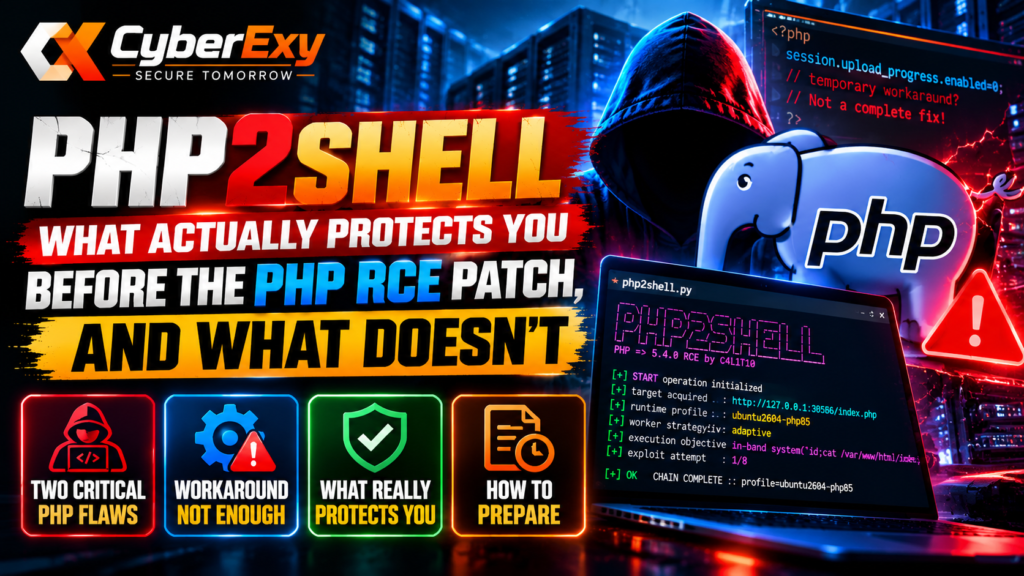
PHP2Shell: Why the PHP RCE Workaround May Not Protect Your Server Before the Patch
Two critical PHP vulnerabilities known as PHP2Shell have raised concerns among web administrators ahead of an emergency security release scheduled for October 21, 2026. Both vulnerabilities have reportedly received a CVSS v4.0 severity score of 9.2, placing them in the critical category.
The immediate concern is whether administrators can reduce their exposure before the official fixes become available. A configuration change involving PHP Session Upload Progress has circulated as a possible workaround, but security researchers have warned that disabling this feature should not be treated as a complete solution.
According to the official PHP security announcement, the release is scheduled for 14:00 UTC on October 21. PHP says the affected versions, fixed versions, and full vulnerability details will be published alongside the release.
What Is PHP2Shell?
PHP2Shell refers to two critical PHP remote code execution vulnerabilities identified as CVE-2026-109618 and CVE-2026-109619 in the supplied research.
Remote code execution vulnerabilities can allow an attacker to make a vulnerable application or server execute unintended code under certain conditions. Depending on the affected environment and the privileges of the PHP process, successful exploitation could put application data, stored credentials, and connected services at risk.
The precise technical details, affected versions, and confirmed attack conditions should be verified against PHP’s official advisory once it becomes available. Until then, administrators should avoid assuming that every PHP installation is affected in the same way.
The most important priority is to identify exposed PHP services, prepare the relevant updates, and reduce unnecessary access to production systems.
Why the Session Upload Progress Setting Is Not a Complete Fix
One workaround discussed by security researchers involves disabling PHP’s Session Upload Progress feature through the configuration directive session.upload_progress.enabled.
This feature allows applications to track the progress of file uploads. Some early research suggested that disabling it might reduce exposure to the reported vulnerabilities.
However, the recommendation was subsequently qualified. The researchers behind the initial suggestion warned that the setting alone should not be considered a complete mitigation and that alternative attack paths might remain possible.
PHP’s core team has also emphasised the importance of installing the official security update rather than relying on an unverified configuration change.
There is an additional uncertainty: the precise relationship between the reported vulnerabilities and Session Upload Progress had not been conclusively established in the pre-release information. Independent analysis has also questioned some claims about the suspected underlying code issue.
Consequently, administrators should treat the configuration change as a possible risk-reduction measure only where appropriate not as proof that a server is safe.

What Should Administrators Do Before the Patch?
While waiting for the official release, organisations should prioritise defensive measures that reduce exposure without relying on an unconfirmed workaround.
1. Restrict Public Access to PHP Applications
Where practical, temporarily place exposed applications behind a VPN, authenticated gateway, or IP allowlist. If a critical service cannot be adequately protected before the patch becomes available, consider temporarily isolating it from public access while evaluating operational requirements.
Ensure that the origin server cannot be reached directly in a way that bypasses the access controls.
2. Reduce the Impact of a Potential Compromise
Review the permissions assigned to PHP worker processes and remove unnecessary privileges. Limit access to sensitive files, application secrets, database credentials, and cloud credentials.
Where possible, separate application workloads and restrict outbound network access so that a compromised web process cannot automatically reach unrelated internal services.
3. Prepare for an Emergency Update
Identify which PHP runtime serves production traffic, whether PHP-FPM, mod_php, or CGI is in use, and determine how the relevant package or container image will be updated.
Prepare a rollback plan, arrange the required approvals, and establish post-update checks. Updating an application framework alone does not necessarily update the PHP runtime beneath it.
4. Review Logging and Monitoring
Ensure that relevant web server, application, authentication, and system logs are being collected and stored securely. Review unusual requests, unexpected application behaviour, and suspicious activity around the time of the vulnerability disclosure.
No exploitation had been reported in the pre-release information supplied for this article. That status can change, so monitoring should continue.

What If You Cannot Install the Patch Immediately?
Organisations unable to update immediately should assess the exposure of each affected service and prioritise systems that are directly reachable from the internet.
The CERT-EU advisory recommends considering the isolation of internet-facing applications from public networks until a fix can be applied.
For older PHP branches that no longer receive upstream security fixes, administrators should consult their operating system or hosting provider to determine whether a supported backport is available. Otherwise, upgrading to a supported branch or isolating the affected service may be necessary.
A web application firewall can provide an additional defensive layer, but it should not be considered a substitute for updating the vulnerable runtime. Filtering rules may miss variations in malicious traffic, and protections only apply to requests that actually pass through the filtering service.
What to Verify When the Official PHP Fix Arrives
When PHP publishes the security release, administrators should:
- Confirm the affected and fixed versions for their deployed branch.
- Update the PHP runtime serving web requests, including the relevant PHP-FPM, Apache module, or CGI installation.
- Follow the release guidance for any required service restarts or configuration changes.
- Test critical application functionality after upgrading.
- Review logs for suspicious activity that occurred before the update.
- Investigate possible compromise if evidence of unauthorised activity is found.
The official PHP downloads page and PHP news archive are appropriate places to check for release information.
Conclusion
PHP2Shell highlights the difficulty of defending internet-facing applications during the period between vulnerability disclosure and patch availability. Disabling Session Upload Progress may be relevant to some configurations, but the available pre-release information does not establish it as a complete fix.
Administrators should focus on reducing public exposure, limiting application privileges, preparing emergency updates, and monitoring for suspicious activity. Once PHP publishes the official advisory and fixed versions, applying the appropriate update should take priority over relying on an unverified workaround.
Security note: This article reflects the pre-release information available before the scheduled October 21, 2026 update. Recheck PHP’s official advisory before publication and revise the article when confirmed affected versions, fixed versions, or mitigation guidance become available.