OffSec PEN-200 Course Guide: OSCP+ Certification 2026

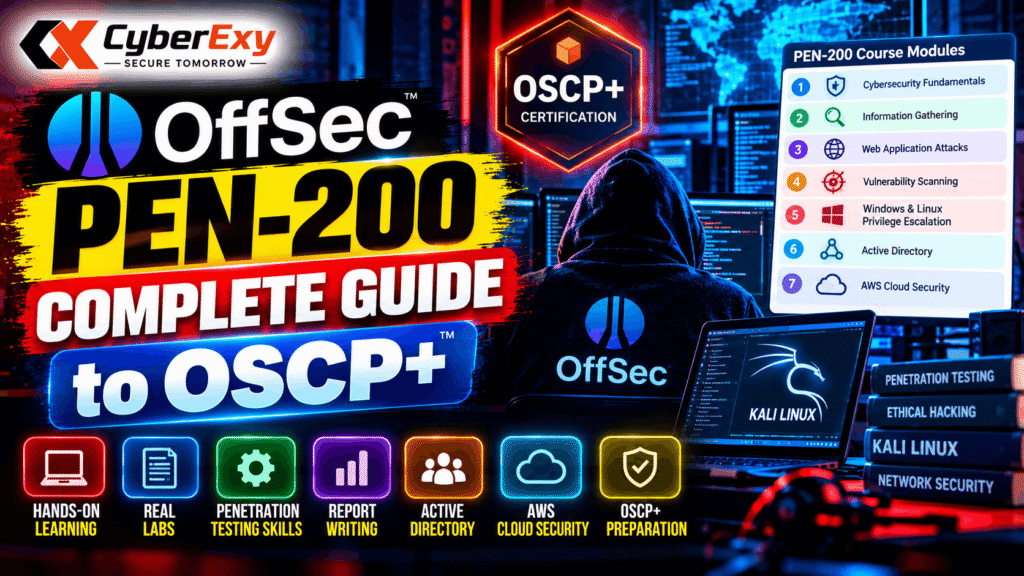
OffSec PEN-200 and OSCP+ Certification: Complete Guide to Penetration Testing Training
The OffSec PEN-200: Penetration Testing with Kali Linux course is a practical cybersecurity training program designed for aspiring penetration testers and security professionals preparing for the OSCP+ certification. It focuses on hands-on learning, structured penetration testing methodology, vulnerability assessment, and professional reporting.
For learners interested in offensive security, PEN-200 provides a structured pathway to develop the technical skills needed to assess systems, investigate security weaknesses, and document findings responsibly.
This guide explains what PEN-200 covers, how the OSCP+ certification works, which skills learners should develop, and how to approach preparation effectively.
What Is OffSec PEN-200?
PEN-200 is an OffSec training course focused on penetration testing with Kali Linux. It combines theoretical concepts with practical exercises and laboratory environments to help learners develop a methodical approach to security assessments.
The course is designed for people pursuing penetration testing roles, cybersecurity professionals expanding their technical skills, and learners preparing for the OSCP+ examination.
Official course information is available on the OffSec PEN-200 website.
Key Topics Covered in PEN-200
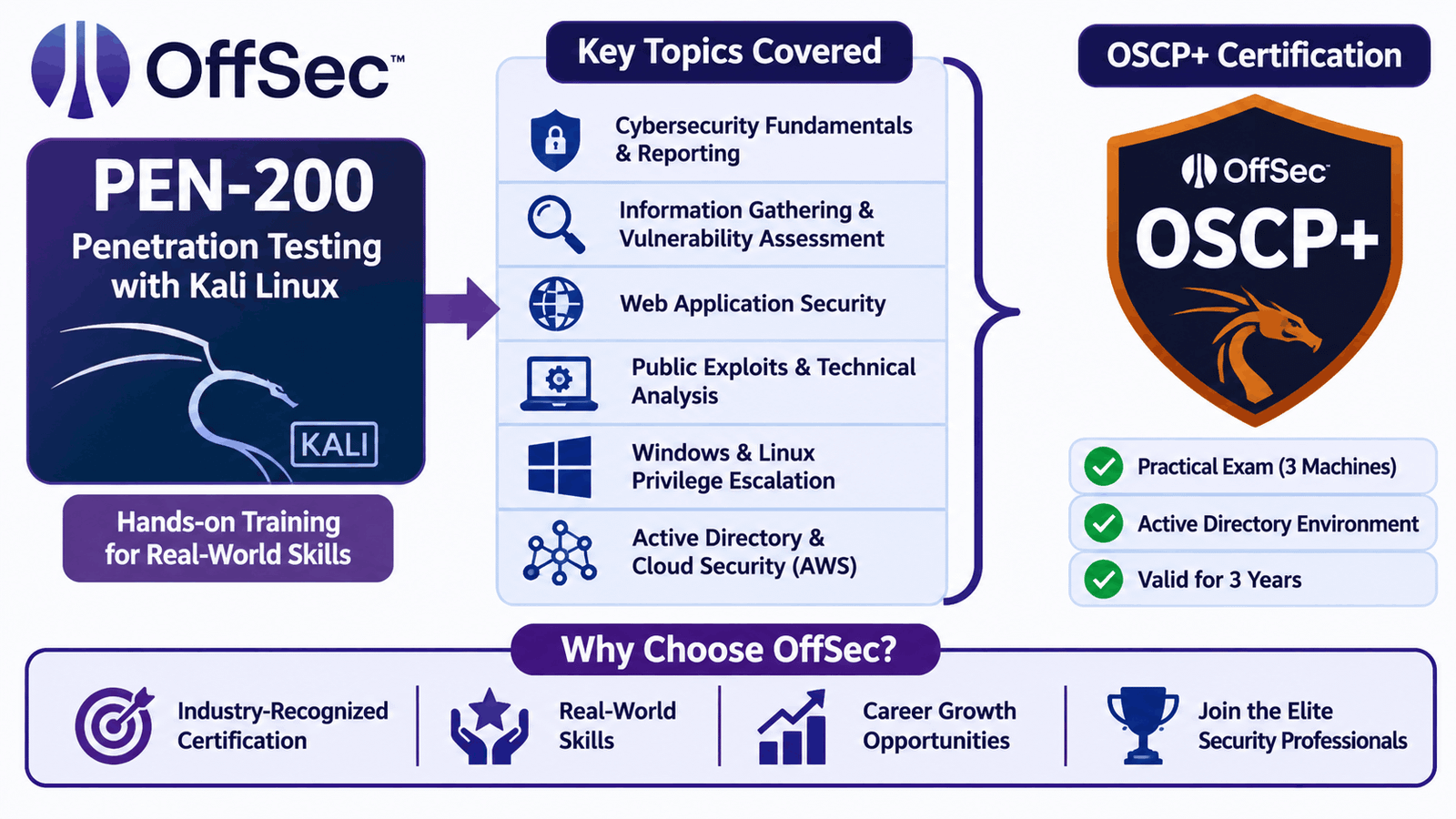
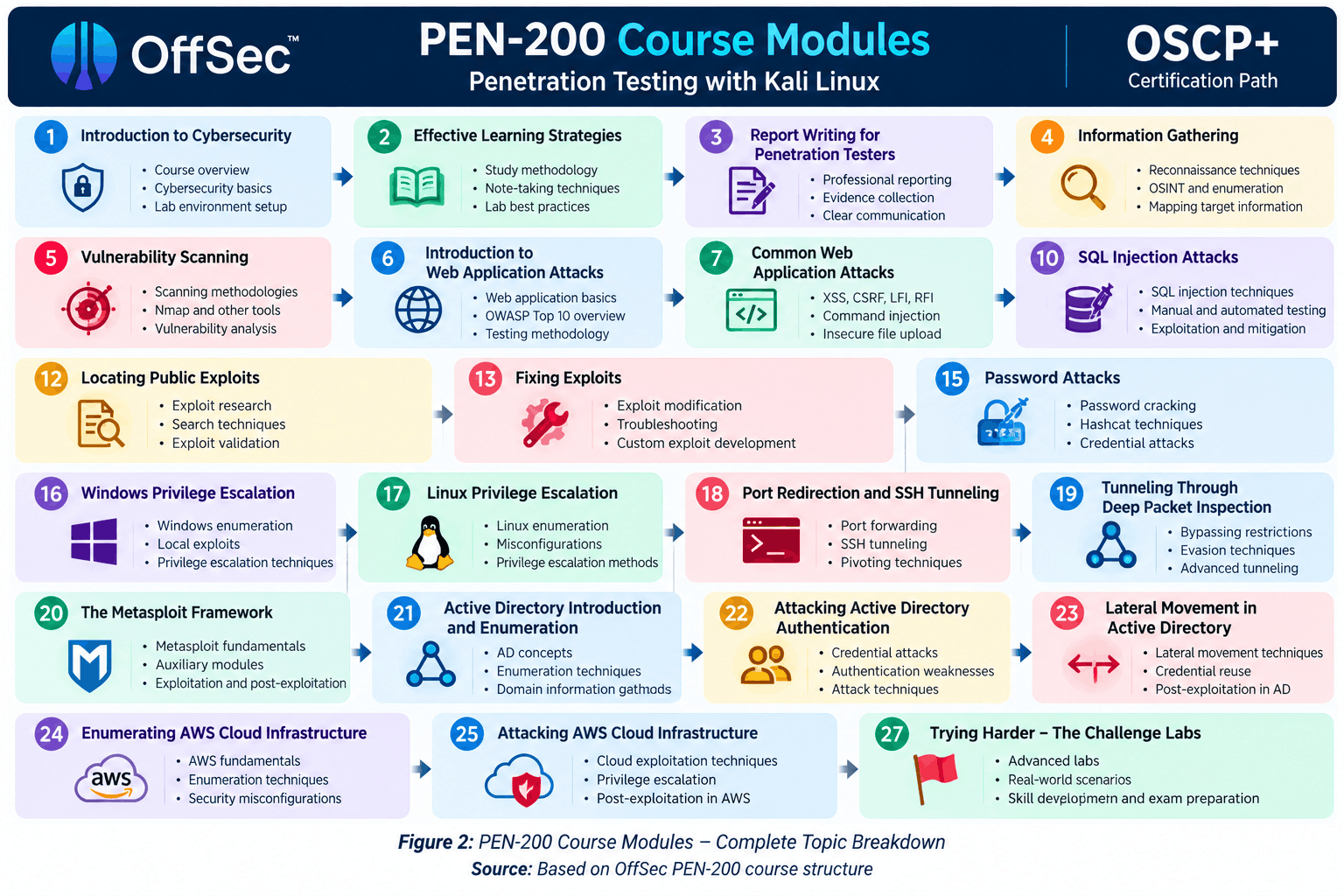
PEN-200 covers a broad range of penetration testing topics, progressing from foundational concepts to more complex enterprise environments.
1. Cybersecurity Fundamentals and Reporting
Learners develop an understanding of cybersecurity principles, effective study strategies, and professional penetration testing reports. Reporting is essential because security findings must communicate risk, evidence, and recommended remediation clearly.
2. Information Gathering and Vulnerability Assessment
Information gathering helps penetration testers understand the systems within an authorized assessment scope. Vulnerability assessment introduces methods for identifying potential weaknesses and evaluating their significance.
3. Web Application Security
The course addresses common web application security weaknesses, including cross-site scripting, SQL injection, command injection, directory traversal, and insecure file-upload functionality.
Understanding these vulnerabilities also helps defenders prioritize secure development practices, input validation, access controls, and application monitoring.
4. Public Exploits and Technical Analysis
Learners explore how publicly documented vulnerabilities and exploit references can inform authorized security assessments. The emphasis should be on understanding the underlying weakness, validating findings in permitted environments, and documenting remediation requirements.
5. Windows and Linux Privilege Escalation
Privilege escalation is an important penetration testing topic involving the identification of security weaknesses that could allow an account to gain more permissions than intended.
Studying Windows and Linux security helps learners understand misconfigurations, excessive privileges, and weaknesses in system administration practices.
6. Active Directory and Cloud Security
Enterprise environments often rely on identity services, centralized authentication, and cloud infrastructure. PEN-200 includes topics relating to Active Directory enumeration, authentication security, and AWS cloud environments.
These areas help learners understand how identity and configuration weaknesses can affect an organization’s wider security posture.
What Is the OSCP+ Certification?
The Offensive Security Certified Professional Plus (OSCP+) is a practical penetration testing certification from OffSec. It assesses candidates’ ability to apply technical knowledge in a controlled examination environment and produce professional documentation.
According to OffSec’s published information, the OSCP+ examination includes three standalone machines and an Active Directory set consisting of three machines. The assessment evaluates practical skills such as initial access, privilege escalation, and completing the required reporting.
The examination is proctored and has a demanding time limit. Candidates should consult the current official OSCP+ Exam Guide for the latest requirements and submission instructions.
An important distinction is that the OSCP+ designation expires after three years, while the underlying OSCP certification remains valid indefinitely under OffSec’s published certification model.
How to Prepare for PEN-200 and OSCP+
Preparation is most effective when learners combine foundational knowledge, consistent practice, and structured review.
Recommended preparation approach:
- Strengthen networking fundamentals: Understand TCP/IP, common protocols, ports, routing, and basic network troubleshooting.
- Build Linux and Windows familiarity: Practise system administration, permissions, command-line navigation, and log analysis.
- Learn scripting basics: Develop familiarity with Python, Bash, or PowerShell to understand automation and system behaviour.
- Practise in authorized laboratories: Use course labs or other environments that explicitly permit security testing.
- Keep detailed notes: Record observations, learning points, evidence, and remediation recommendations.
- Practise report writing: Explain findings clearly, describe their impact, and provide actionable defensive recommendations.
- Review the current exam guide: Confirm the examination structure, scoring requirements, permitted resources, and reporting rules before scheduling an attempt.
A consistent learning plan is more useful than rushing through material. Learners should focus on understanding why a weakness exists, how to recognize it, and how organizations can prevent or remediate it.
Who Should Consider PEN-200?
PEN-200 may be suitable for:
- Aspiring penetration testers.
- Cybersecurity students with foundational technical knowledge.
- IT professionals transitioning into security.
- Security analysts seeking deeper offensive-security knowledge.
- Experienced practitioners preparing for the OSCP+ assessment.
Before beginning, learners should have a reasonable understanding of TCP/IP networking and basic Windows and Linux administration. Reviewing the official course prerequisites can help identify any knowledge gaps.
Where to Access Official PEN-200 Training
The safest and most reliable way to obtain the course materials, laboratory access, and associated examination options is through OffSec’s official platform.
Official resources:
- PEN-200 course overview and enrollment
- PEN-200 frequently asked questions
- OSCP+ examination guide
- OSCP+ candidate handbook
Course prices, access periods, and examination terms can change, so review the official pages before making a purchase.

Final Thoughts
OffSec PEN-200 provides a structured route into practical penetration testing, while OSCP+ offers a way to demonstrate applied offensive-security skills through a proctored examination.
Success depends on more than familiarity with security tools. Strong networking knowledge, careful enumeration, systematic problem-solving, responsible testing, and clear technical reporting are all important parts of professional penetration testing.
For learners building a cybersecurity career, the best approach is to use authorized training environments, develop a consistent study routine, and focus on understanding security weaknesses well enough to explain and remediate them.
Explore the official training: https://www.offsec.com/courses/pen-200/
Follow CyberExy — Secure Tomorrow for cybersecurity education, certification guides, and security news.