AWS DevOps Engineer Training: Complete Course Guide

AWS Certified DevOps Engineer Training Course: Complete Guide to CI/CD, CloudFormation and Automation
AWS DevOps Engineer training can help IT professionals understand how modern applications are built, deployed and maintained in cloud environments. As organisations increasingly adopt cloud computing, automation and continuous delivery, DevOps skills are valuable for cloud engineers, software developers, system administrators and infrastructure professionals.
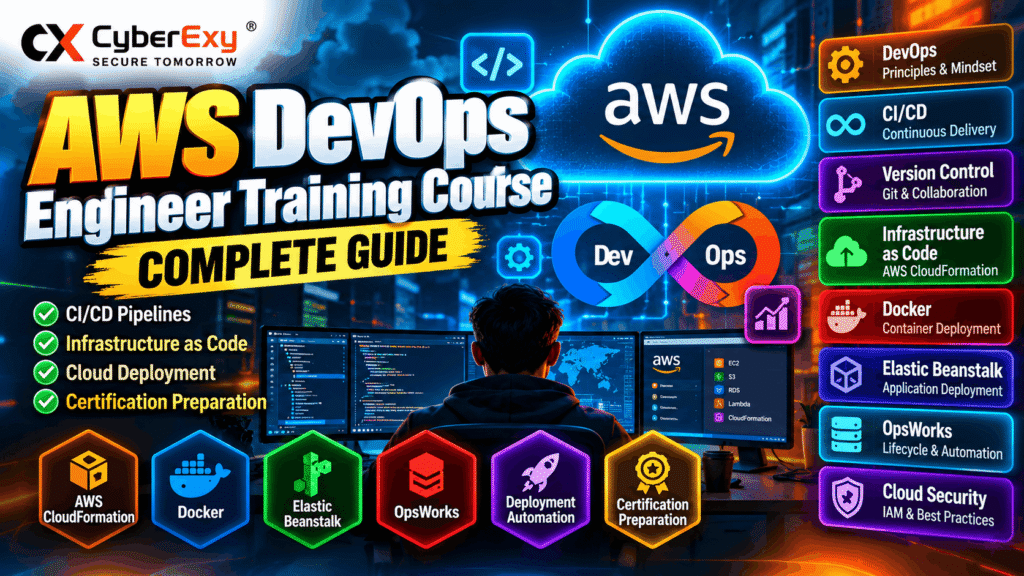
The training course featured in this guide covers several core DevOps concepts and AWS services, including continuous integration and continuous delivery (CI/CD), version control, Infrastructure as Code (IaC), AWS CloudFormation, Docker, Elastic Beanstalk and AWS OpsWorks.
For learners preparing for an AWS certification or building practical cloud engineering skills, these topics provide a foundation for understanding automated deployments and cloud operations.
What Is AWS DevOps Engineer Training?
AWS DevOps training introduces the tools, processes and principles used to automate software delivery and manage applications running on Amazon Web Services.
DevOps combines development and operations practices to improve collaboration, deployment consistency and operational reliability. Instead of relying entirely on manual processes, teams use automation to test code, provision infrastructure, deploy applications and monitor services.
Training can help learners understand how these practices work together, from version control and application development to deployment and ongoing infrastructure management.
It is important to distinguish a training course from an official certification. Completing video lessons does not itself award an AWS certification or guarantee a successful exam result.
Key Topics Covered in the Course
1. DevOps Principles and Mindset
The course begins with an overview of the learning material and an introduction to the DevOps mindset. This foundation helps learners understand why development and operations teams increasingly work together throughout the software lifecycle.
Important concepts include collaboration, automation, repeatable workflows and continuous improvement. These principles can help organisations reduce manual effort and identify problems earlier in the delivery process.
2. Continuous Integration and Continuous Delivery (CI/CD)
CI/CD is a central part of modern DevOps engineering.
Continuous integration involves regularly combining code changes and validating them through automated checks. Continuous delivery focuses on preparing application changes for reliable release, while continuous deployment can automatically release qualifying changes to production.
Learners should understand how source control, automated testing, build processes and deployment stages fit into a pipeline. These concepts help teams deliver software more consistently and reduce errors associated with manual releases.
3. Version Control
Version control systems help development teams track code changes, collaborate and recover earlier versions when necessary.
Understanding version control is useful when working with CI/CD pipelines and infrastructure configuration because changes to application code and deployment definitions need to be managed systematically.
4. Infrastructure as Code and AWS CloudFormation
Infrastructure as Code allows teams to define infrastructure through configuration files instead of creating every resource manually.
The supplied course curriculum includes several CloudFormation topics:
- Implementing CloudFormation templates
- Deletion policies
- Intrinsic functions
- Parameters
- Nested templates
- Wait conditions
- Custom resources
These topics introduce methods for defining and managing AWS infrastructure consistently. Nested templates can help organise larger deployments, while parameters allow templates to accept configurable values.
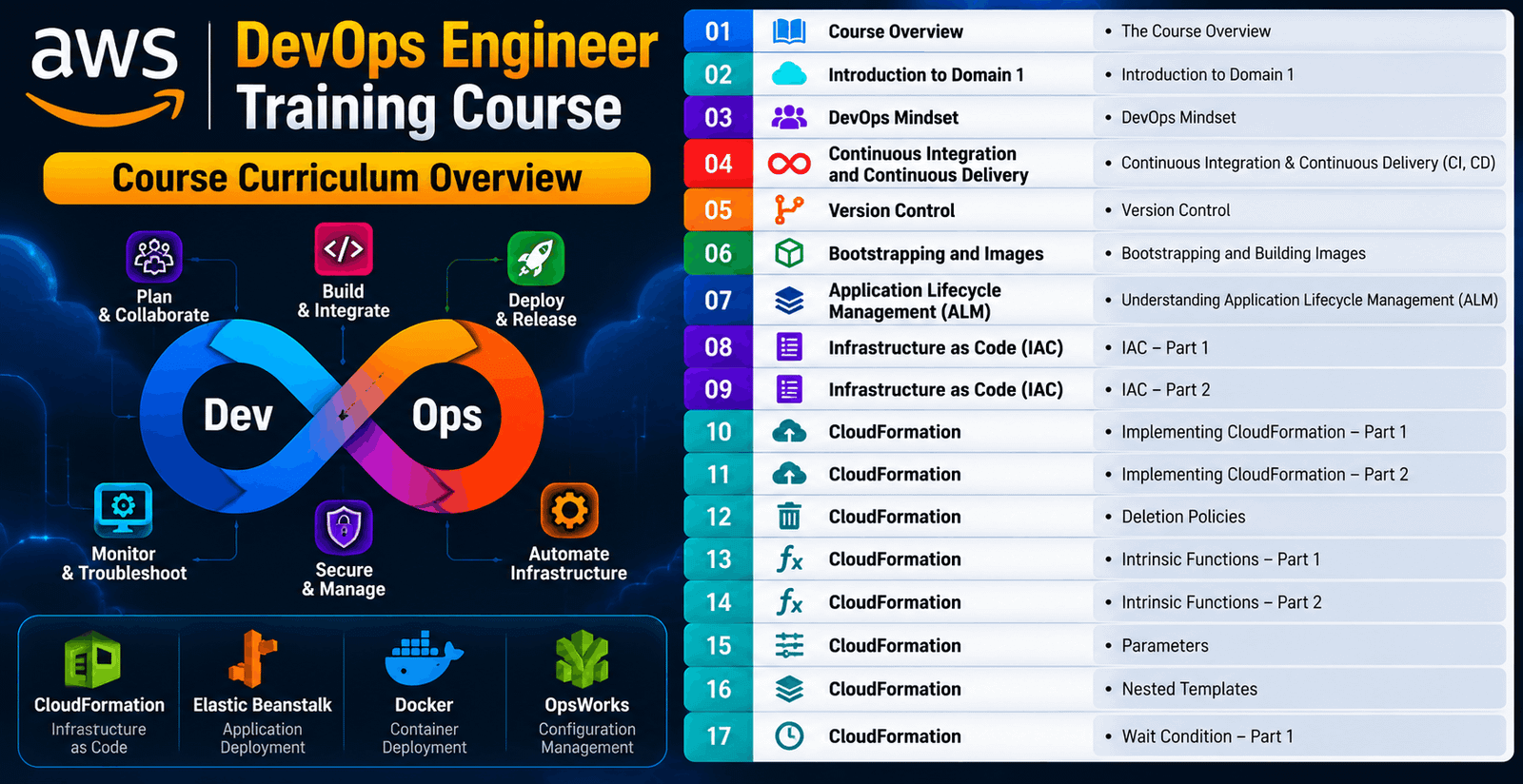
Figure : AWS DevOps training curriculum showing lessons on CI/CD, version control, Infrastructure as Code and AWS CloudFormation. Source: supplied course screenshots.
5. Docker and Container-Based Deployment
Docker is used to package applications and their dependencies into containers. Containerisation can make application environments more consistent across development, testing and deployment.
The course includes a Docker lesson and a separate lesson covering Docker with AWS Elastic Beanstalk. Learners can use these topics to build an understanding of container-based application delivery and the role containers play in cloud deployment workflows.
6. AWS Elastic Beanstalk
AWS Elastic Beanstalk helps developers deploy and manage supported applications while AWS handles much of the underlying environment management.
The visible curriculum includes an overview of Elastic Beanstalk, its features, extensions, command-line interface, and web versus worker environments.
It also covers the blue-green deployment model. This approach uses separate environments to support controlled releases and can make it easier to validate a new version before directing production traffic to it.
Understanding these concepts helps learners explore application deployment strategies and the operational considerations involved in releasing software.
7. AWS OpsWorks and Application Lifecycle Management
The course also introduces AWS OpsWorks, including lifecycle events, command deployments and auto-healing capabilities. These lessons cover concepts associated with configuration management and operational automation.
Application Lifecycle Management (ALM) is another listed topic. It concerns the processes used to manage an application from development through deployment, maintenance and eventual retirement.
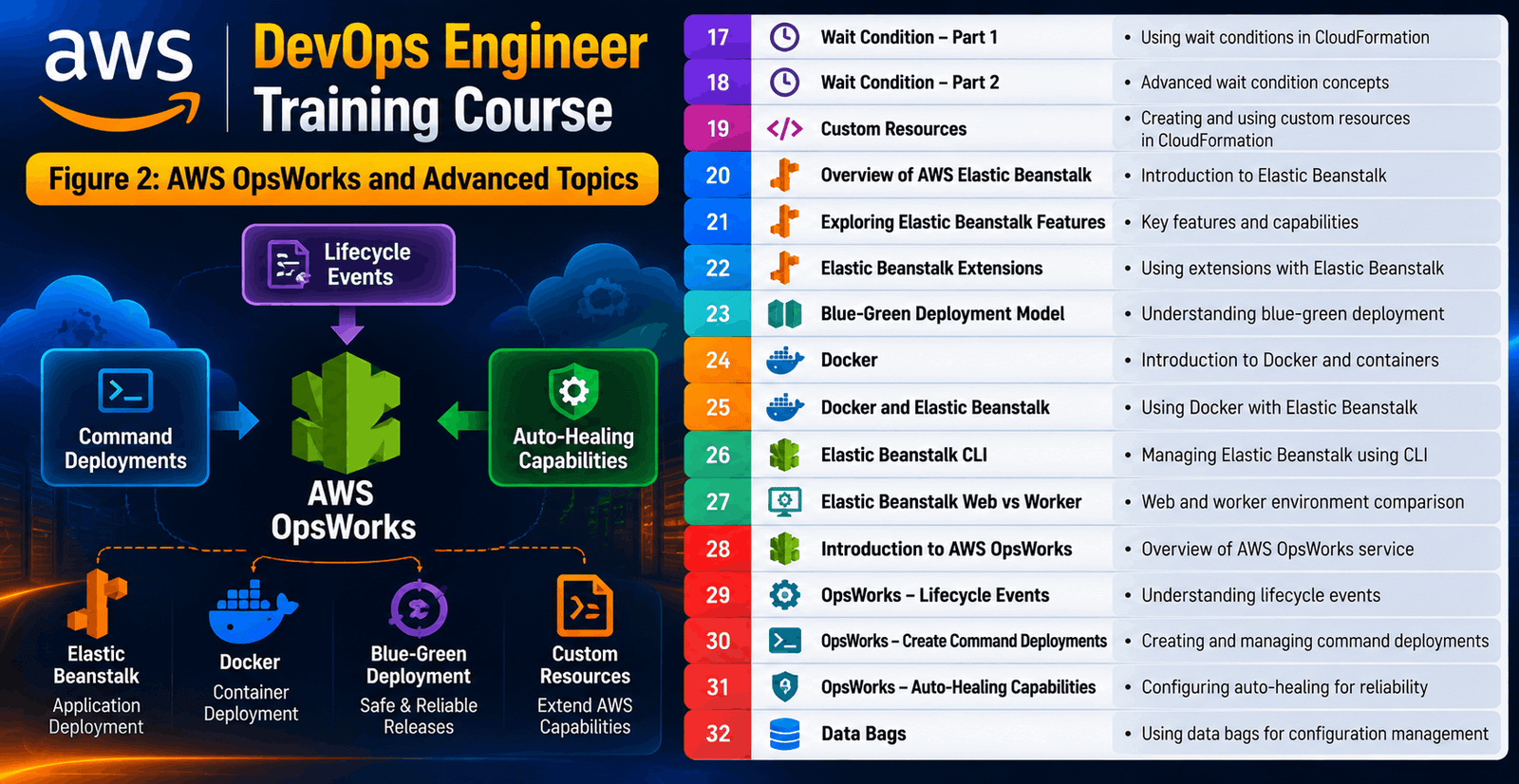
Figure : Course modules covering AWS OpsWorks, lifecycle events, command deployments and auto-healing capabilities. Source: supplied course screenshots.
Who Should Take This Training?
This course may be useful for:
- Cloud engineers developing AWS deployment skills
- DevOps beginners learning automation fundamentals
- Software developers exploring CI/CD
- System administrators moving into cloud operations
- IT professionals preparing for relevant AWS certification exams
Learners who are new to cloud computing may benefit from first becoming familiar with basic networking, Linux commands, Git and core AWS services.
How to Get the Most From the Course
Watching training videos is a useful starting point, but practical work is important for developing real skills.
Consider reinforcing the lessons with exercises such as:
- Create a simple CI/CD pipeline in a suitable practice environment.
- Write and validate a basic CloudFormation template.
- Deploy a sample application to Elastic Beanstalk.
- Practise building and running a Docker container.
- Review AWS Identity and Access Management (IAM) permissions.
- Explore application logs, monitoring and deployment troubleshooting.
Use an appropriate test environment, follow AWS security guidance and monitor costs when creating cloud resources.
Does This Course Prepare You for AWS Certification?
The course may support DevOps certification preparation, but the visible lesson list does not prove that it covers every objective of the current AWS Certified DevOps Engineer – Professional exam.
Before enrolling or scheduling an exam, compare the course syllabus with the official AWS certification guide. Confirm the current exam requirements, recommended experience and any changes to the certification programme.
Conclusion
AWS DevOps Engineer training can help learners develop an understanding of CI/CD, version control, Infrastructure as Code, CloudFormation, Docker, Elastic Beanstalk and AWS OpsWorks.
These topics provide a useful starting point for understanding automated software delivery and cloud infrastructure management. Combining structured lessons with practical exercises and current AWS documentation can make the learning experience more effective.
Final recommendation: Treat this course as a learning resource, practise the concepts in a controlled environment, and verify certification coverage against the official AWS exam guide before relying on it as your sole preparation material.