
OffSec AI-300 OSAI Certification: Complete Guide 2026

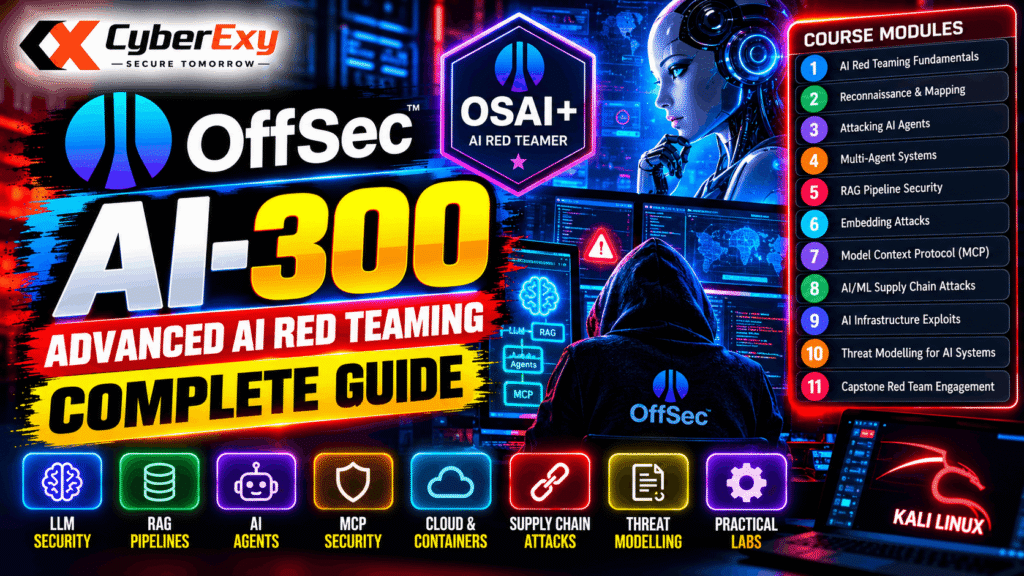
OffSec AI-300 (OSAI) Certification: Complete Guide to Advanced AI Red Teaming in 2026
Meta title: OffSec AI-300 OSAI Certification: Complete Guide 2026
Artificial intelligence is transforming cybersecurity, software development, cloud infrastructure, and enterprise automation. Organizations increasingly rely on large language models (LLMs), AI agents, retrieval-augmented generation (RAG), machine learning pipelines, and connected tools to perform business-critical tasks. While these technologies introduce new capabilities, they also create security risks that traditional penetration testing may not fully address.
To help security professionals assess these emerging threats, Offensive Security (OffSec) offers AI-300: Advanced AI Red Teaming, a hands-on training program associated with the OffSec AI Red Teamer (OSAI) certification.
The course focuses on assessing AI-enabled applications, agent-based systems, model integrations, machine learning components, and the infrastructure supporting them. It combines AI security concepts with practical red teaming exercises designed to help learners understand how weaknesses in connected AI systems can affect an organization’s overall security posture.
For penetration testers, red teamers, security engineers, and AI professionals, AI-300 provides a structured opportunity to develop specialized knowledge in an evolving cybersecurity discipline.
In this comprehensive guide, we cover the AI-300 syllabus, important AI security concepts, certification requirements, exam structure, preparation strategies, and official training resources.
Official course: OffSec AI-300 — Advanced AI Red Teaming
What Is OffSec AI-300?
OffSec AI-300, titled Advanced AI Red Teaming, is an advanced, self-paced training course designed for cybersecurity practitioners and AI professionals who want to assess the security of AI-integrated systems.
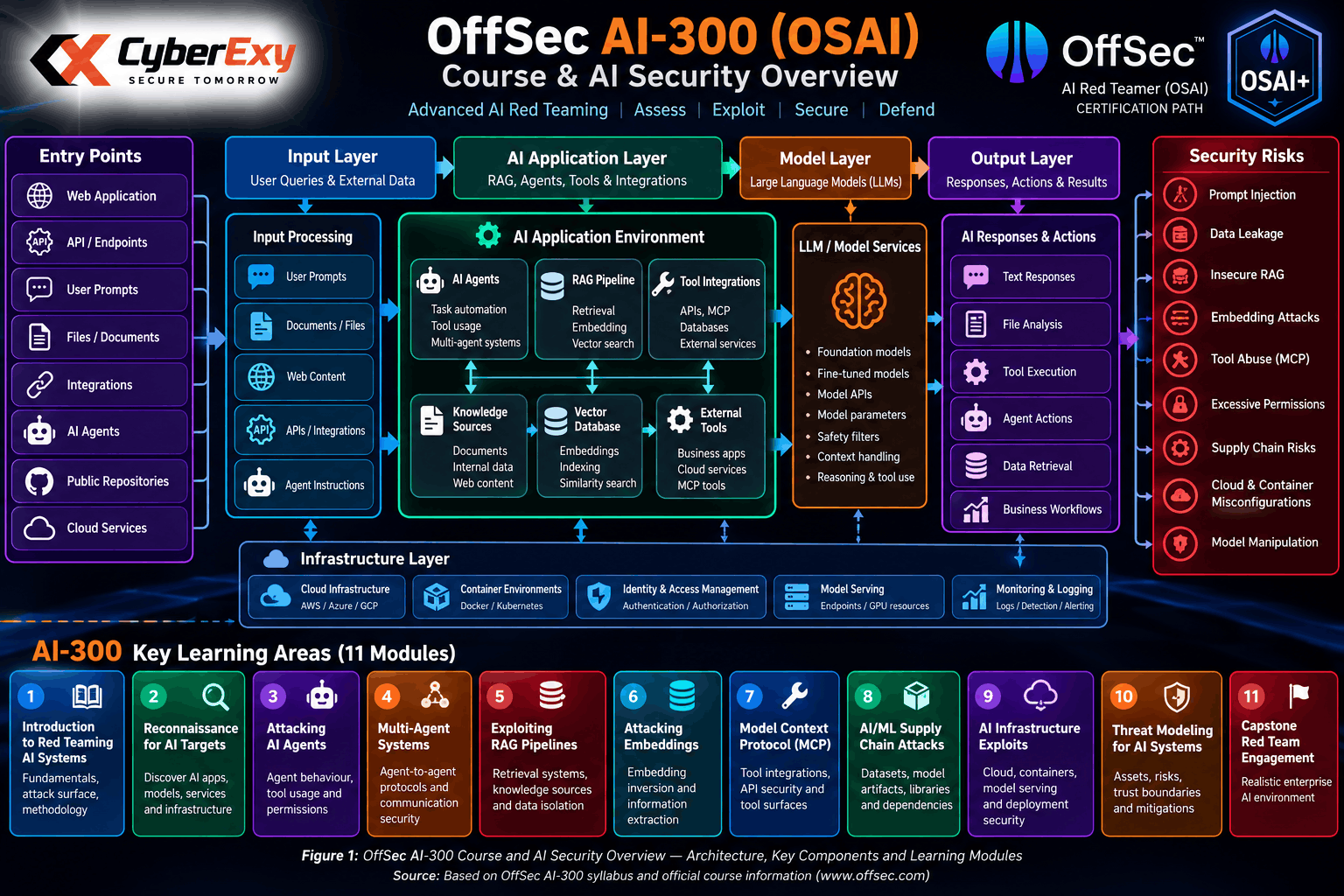
Traditional penetration testing frequently focuses on networks, operating systems, web applications, identity systems, and conventional infrastructure. AI red teaming extends this assessment perspective to systems in which model behaviour, external data sources, automated agents, tool integrations, and machine learning components influence application security.
For example, an enterprise AI assistant might retrieve confidential documents, interact with internal business tools, or process information from external sources. If the application has inadequate access controls or fails to separate trusted instructions from untrusted content, the AI system may expose information or perform actions beyond its intended permissions.
AI-300 explores the security implications of these interconnected components through structured learning and practical exercises.
According to OffSec’s published syllabus, the course contains 11 modules, culminating in a capstone red team engagement against a realistic enterprise AI environment.
Official resources:
What Is AI Red Teaming?
AI red teaming is the structured evaluation of AI systems to identify security weaknesses, unsafe behaviour, unintended access, and other risks that could affect confidentiality, integrity, or availability.
The process examines not only the model itself but also the wider application environment. This can include the prompts and instructions supplied to a model, external knowledge sources, identity and permission systems, connected tools, APIs, deployment infrastructure, and data processing pipelines.
A useful distinction is that AI red teaming is broader than testing whether a model produces an undesirable response. A complete assessment also considers what information the system can access, what actions it can perform, how its components communicate, and whether safeguards remain effective under adversarial conditions.
Common areas of assessment include:
- Prompt injection and instruction-handling weaknesses.
- AI agent permissions and tool-access boundaries.
- Exposure of confidential information.
- Security of retrieval-augmented generation systems.
- Embedding and data-processing risks.
- Model Context Protocol (MCP) integrations.
- AI and machine learning supply-chain security.
- Cloud, container, and model-serving infrastructure.
- Trust boundaries in multi-agent systems.
- Threat modelling for AI-enabled enterprise applications.
The objective is to help organizations identify and remediate weaknesses before they result in security incidents.
OffSec AI-300 Course Syllabus: All 11 Modules Explained
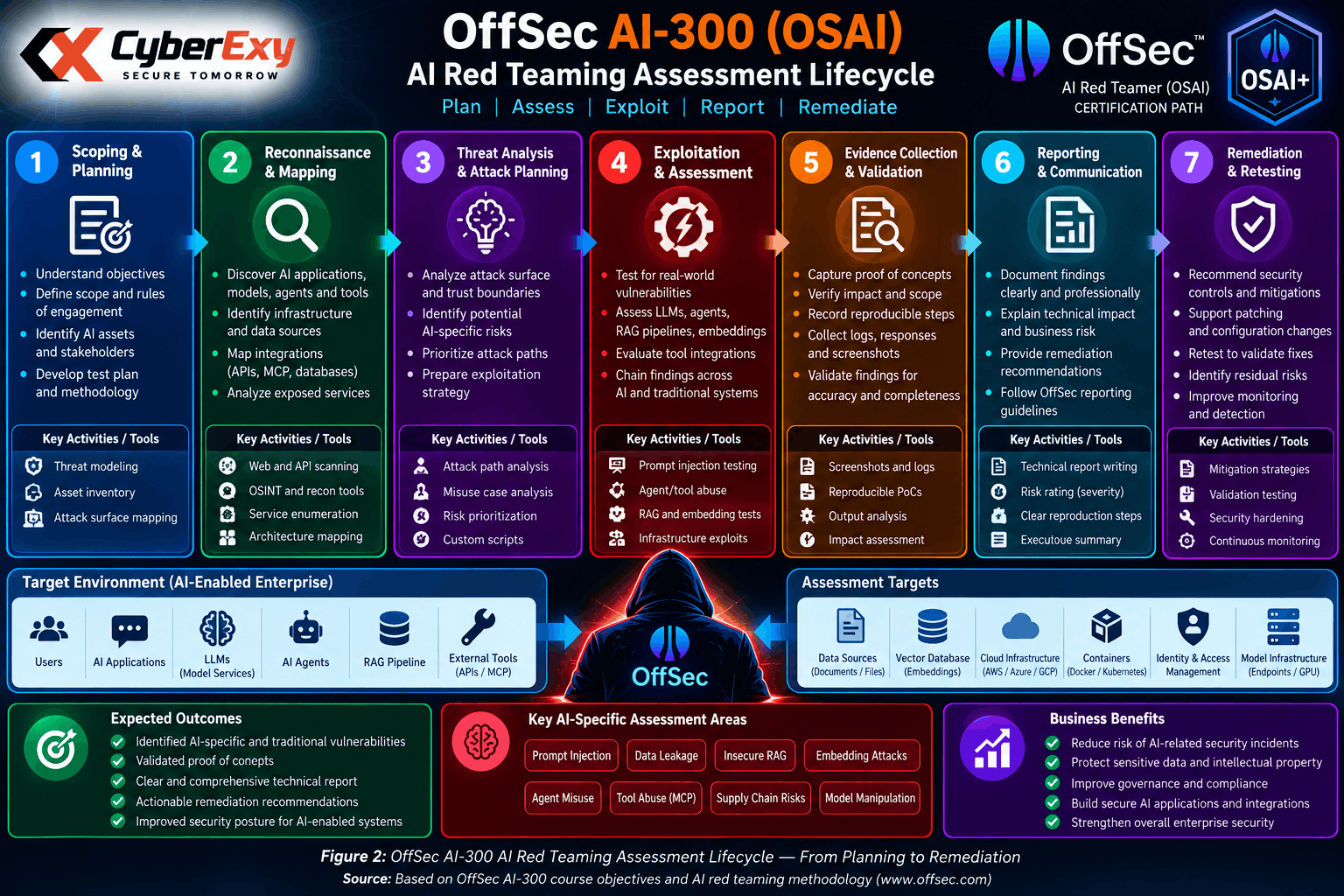
OffSec’s official syllabus identifies 11 modules. The following overview explains the purpose of each topic without reproducing proprietary course materials.
Module 1: Introduction to Red Teaming AI Systems
The first module introduces the security challenges associated with AI-enabled environments and explains how AI changes the traditional application attack surface.
Learners explore the relationship between AI systems and established red teaming principles, including asset identification, risk assessment, security boundaries, and structured reporting.
Important concepts include:
- AI security fundamentals.
- The AI red teaming lifecycle.
- AI-specific attack surfaces.
- Trust boundaries and security assumptions.
- The relationship between traditional and AI-focused testing.
This foundation helps learners understand why AI systems require assessment methods that consider both conventional infrastructure and model-related behaviour.
Module 2: Reconnaissance for AI Targets
Reconnaissance involves developing an understanding of the systems included in an authorized security assessment.
For AI environments, this may involve identifying AI applications, model-serving components, dependencies, exposed services, and supporting infrastructure. Understanding the relationships between these components helps security teams identify where security controls should be evaluated.
The module introduces AI-specific asset discovery and the importance of documenting the system architecture before assessing its security.
From a defensive perspective, organizations should maintain inventories of deployed AI applications, external model providers, connected services, and data sources.
Module 3: Attacking AI Agents
AI agents can use models to interpret instructions, retain context, interact with tools, and perform multi-step tasks. These capabilities can increase productivity but also introduce additional security concerns.
An agent with excessive permissions or inadequate safeguards may make decisions that exceed its intended responsibilities.
This module explores weaknesses involving agent instructions, memory systems, and tool integrations.
Important defensive considerations include:
- Applying least-privilege access.
- Requiring authorization for sensitive actions.
- Separating untrusted input from trusted instructions.
- Limiting access to confidential information.
- Maintaining logs of consequential agent actions.
- Providing human oversight for high-impact operations.
The key lesson is that AI agents should not automatically receive broad permissions simply because they can interpret natural-language requests.
Module 4: Attacking Multi-Agent Systems and Agent-to-Agent Protocols
Some AI applications use multiple specialized agents that exchange information or coordinate tasks. For example, one agent may retrieve information, another may analyse it, and a third may prepare a response.
This architecture introduces trust relationships between components. If one agent processes untrusted information or makes an incorrect assumption, that information may influence other agents downstream.
The fourth module examines security concerns associated with multi-agent architectures and agent-to-agent communication.
Defenders should consider message integrity, agent identity, authorization boundaries, validation of inter-agent requests, and the ability to audit workflows.
A secure multi-agent system needs clear rules governing which agents can communicate, what information they may share, and which actions they are permitted to initiate.
Module 5: Exploiting RAG Pipelines
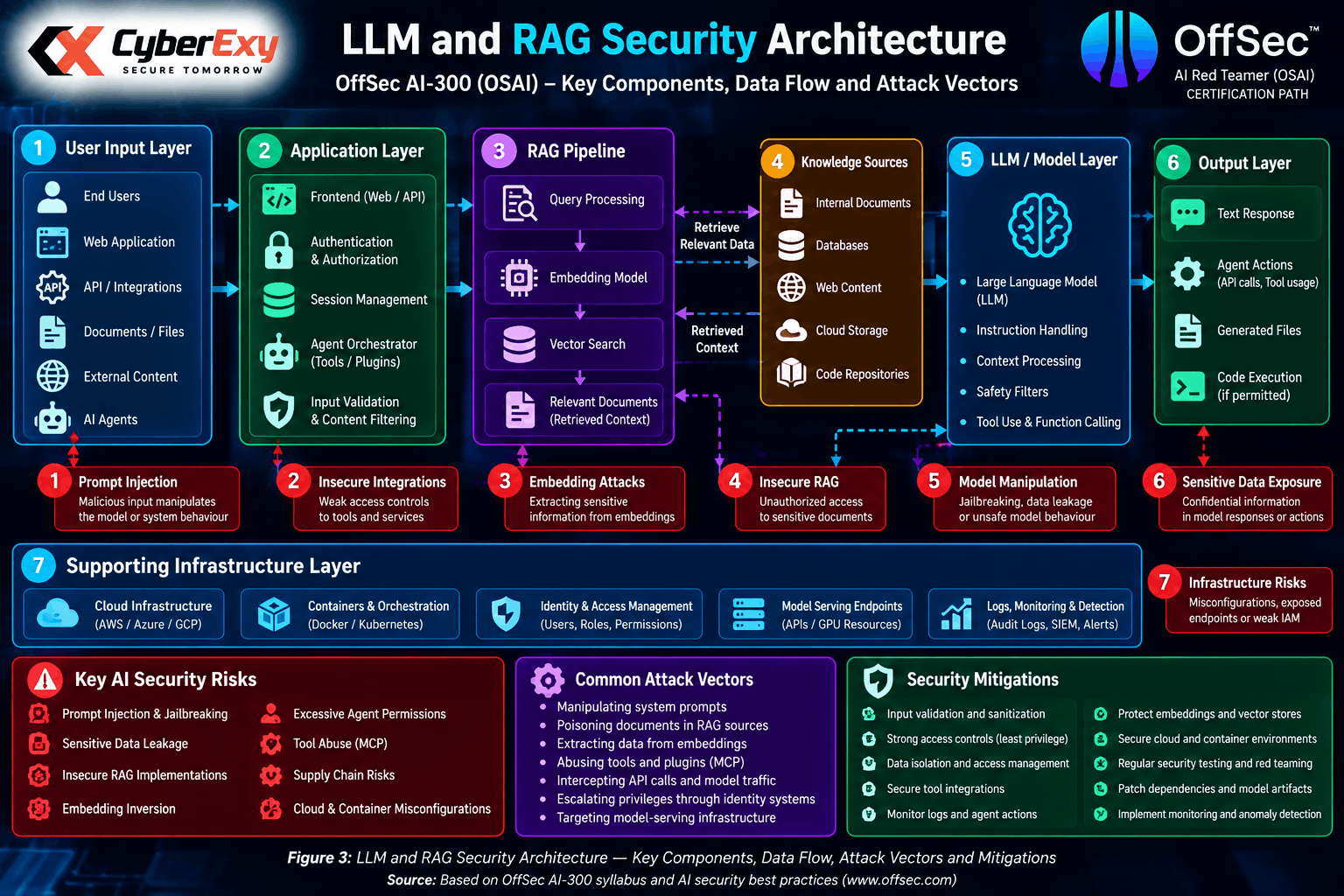
Retrieval-augmented generation, commonly known as RAG, connects a language model to an external information source. Instead of relying exclusively on information learned during training, the application retrieves relevant content and supplies it to the model when generating a response.
RAG is widely used in enterprise search, document assistants, customer support, and internal knowledge-management applications.
However, security problems can arise when the system does not properly control its information sources, retrieval permissions, or treatment of untrusted documents.
The module explores the security of RAG pipelines, including risks associated with knowledge sources and retrieval components.
Key defensive considerations include:
- Enforcing document-level access controls.
- Separating information belonging to different users or organizations.
- Validating the provenance of knowledge sources.
- Monitoring changes to indexed content.
- Testing retrieval permissions and data isolation.
- Treating retrieved content as data rather than automatically trusted instructions.
A RAG application should not return confidential information simply because a model can retrieve a document containing it.
Module 6: Attacking Embeddings
Embeddings are numerical representations of information that help machine learning systems compare semantic similarity and retrieve related content.
They are commonly used in vector databases, semantic search, recommendation systems, and RAG applications.
Although embeddings are not normally presented as readable copies of their original text, they can still create privacy and information-security concerns. Depending on the system and available auxiliary information, embedding-related attacks may reveal sensitive properties or contribute to the recovery of information.
The AI-300 syllabus covers embedding inversion and information extraction as areas of study.
Organizations should evaluate the sensitivity of data entering embedding pipelines, restrict access to vector stores, and avoid assuming that transformed data is automatically anonymous or safe to expose.
Module 7: Attacking Model Context Protocol and Tool Surfaces
The Model Context Protocol (MCP) is a protocol used to connect AI applications with external tools and data sources. Such integrations can help AI systems interact with business applications, repositories, databases, and other services.
However, every integration introduces additional security considerations. Problems can arise when an AI application trusts an external tool too broadly, fails to validate permissions, or allows sensitive actions without appropriate authorization.
This module focuses on security risks associated with tool integration and orchestration layers.
Important defensive measures include:
- Authenticating users and connected services.
- Applying least-privilege permissions to tools.
- Validating tool requests and returned data.
- Requiring approval for sensitive actions.
- Separating read-only functions from operations that modify data.
- Monitoring tool activity and preserving audit records.
AI integrations should be treated as part of the application’s security boundary, not as harmless extensions of a language model.
Module 8: Supply Chain Attacks on AI/ML Systems
AI applications depend on multiple components, including datasets, model weights, adapters, software libraries, container images, and deployment tools.
A weakness in any of these dependencies can undermine the security of the complete application.
The AI-300 syllabus covers supply-chain risks involving datasets, model artifacts, dependencies, and other components used in AI and machine learning environments.
Organizations can reduce these risks by establishing controlled acquisition processes, verifying artifact integrity, maintaining dependency inventories, reviewing third-party components, and restricting who can modify production models and datasets.
Supply-chain security is particularly important when teams integrate models or libraries from external sources without a consistent review process.
Module 9: AI Infrastructure and Deployment Exploits
AI systems depend on infrastructure to serve models, process requests, store data, and connect to external services.
Depending on the deployment, this infrastructure may include cloud AI platforms, model-serving endpoints, containerized workloads, orchestration systems, and storage services.
The ninth module examines vulnerabilities affecting AI infrastructure and deployment environments.
Defensive priorities include secure configuration, network segmentation, identity management, secrets protection, container security, and continuous monitoring.
Organizations should also ensure that development and testing environments do not expose production credentials or sensitive customer information.
Protecting the model alone is insufficient if the infrastructure around it is poorly configured.
Module 10: Threat Modeling for AI-Enabled Targets
Threat modelling helps security professionals identify valuable assets, understand trust boundaries, evaluate likely threats, and prioritize appropriate controls.
AI systems require threat models that account for both traditional components and AI-specific behaviour.
For example, an enterprise assistant may rely on a language model, a retrieval service, a vector database, user authentication, and several connected tools. Each component may introduce different security requirements.
The tenth module focuses on developing threat models for complex AI-enabled environments.
A practical threat model should identify:
- Sensitive data and business-critical assets.
- Users, services, and external dependencies.
- Trust boundaries between components.
- Authentication and authorization requirements.
- Potential misuse scenarios.
- Existing safeguards and residual risks.
- Recommended remediation and validation activities.
Threat modelling helps teams make security decisions before weaknesses become incidents.
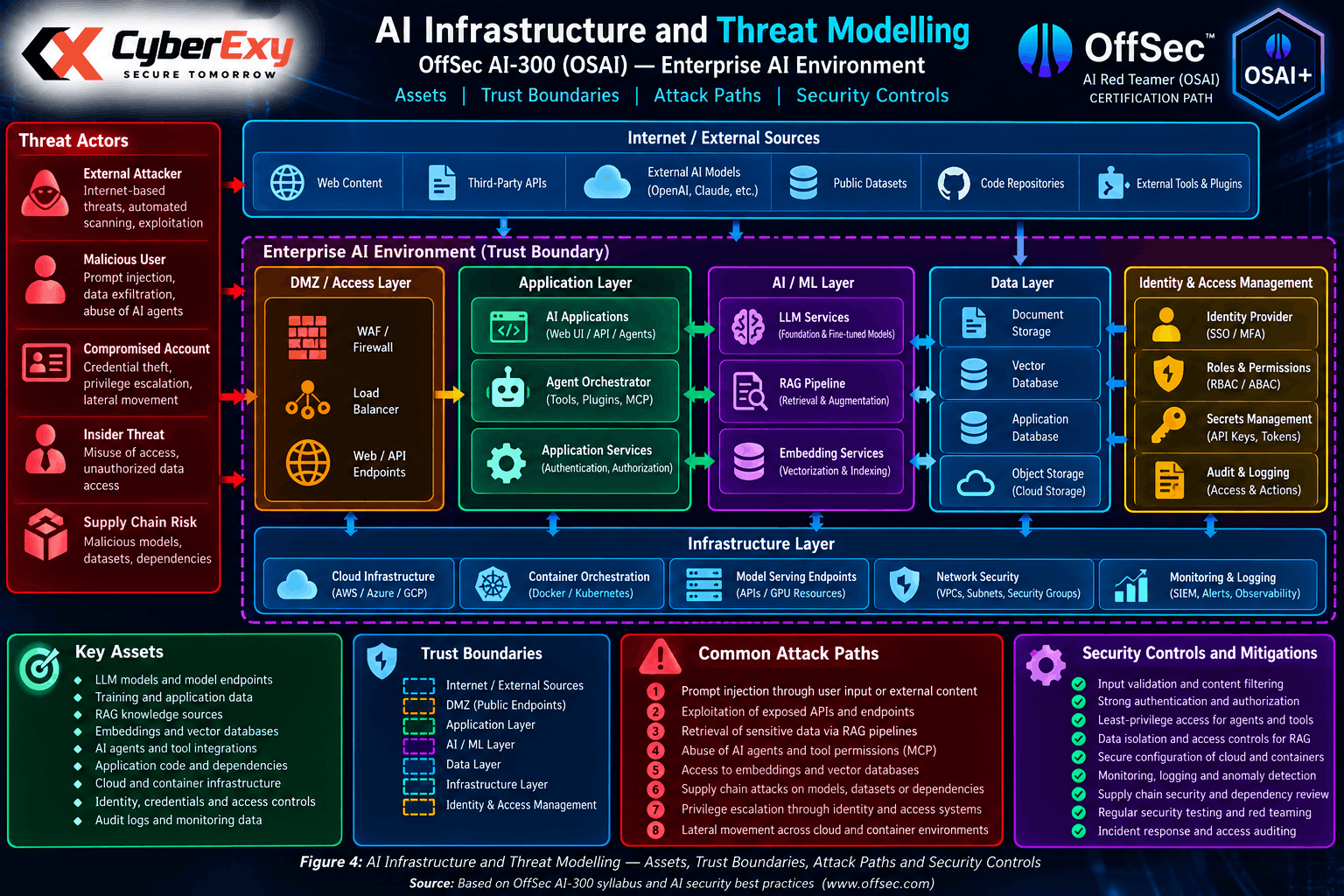
Module 11: Assembling the Pieces — Capstone Red Team Engagement
The final module brings together the concepts introduced throughout the course in a capstone engagement involving a realistic enterprise AI environment.
Rather than considering individual components in isolation, the capstone focuses on assessing how different weaknesses and dependencies interact across a wider system.
This type of assessment requires technical reasoning, careful evidence collection, structured documentation, and an understanding of how security issues affect the organization as a whole.
The capstone reinforces an important professional skill: translating technical findings into a clear account of risk and actionable recommendations.
The official syllabus is the authoritative source for the course’s complete module descriptions.
What Is the OSAI Certification?
OSAI stands for OffSec AI Red Teamer. It is the certification associated with OffSec’s Advanced AI Red Teaming training.
The certification is designed to demonstrate practical skills in evaluating AI-enabled systems and understanding both AI-focused and traditional attack vectors.
Unlike a purely theoretical examination, the OSAI assessment involves a hands-on red team engagement in a simulated enterprise environment. Candidates must identify security weaknesses, demonstrate the required findings, and document their work.
For professionals working in AI security, the certification provides a structured way to demonstrate knowledge of AI-related attack surfaces, infrastructure, and assessment methodology.
Official information:
OSAI vs. OSAI+: What Is the Difference?
OffSec’s certification guidance distinguishes between the base OSAI credential and the OSAI+ designation.
According to the official AI-300 FAQ:
- OSAI: The base certification does not expire.
- OSAI+: The additional designation expires three years after issuance.
- Candidates who pass the OSAI+ examination earn both OSAI and OSAI+.
- Continuing-education pathways are available for maintaining the OSAI+ designation.
Certification policies can change, so candidates should confirm the current requirements directly with OffSec before registering.
OSAI Exam Format and Requirements
The official OSAI examination guide describes a proctored, 24-hour practical assessment of an AI-enabled enterprise environment. Candidates then have an additional 24 hours to submit their examination documentation.
The assessment covers AI-focused and traditional attack vectors across a simulated environment. The official guide describes multiple attack chains, a domain controller, and a separate AI-focused host.
OffSec states that candidates must achieve at least 75 points out of 100 to pass. Documentation is an important part of the assessment, and missing required evidence can result in lost points or disqualification.
Candidates should review the complete official OSAI Exam Guide for the current examination rules, evidence requirements, submission format, and scoring details.
Why Technical Documentation Matters
A professional security assessment must explain what was tested, what was discovered, why the findings matter, and how the organization can reproduce or validate them.
For the OSAI examination, OffSec specifies detailed documentation requirements, including supporting screenshots and a structured report.
Learners preparing for a practical assessment should develop a consistent documentation process during training rather than leaving report writing until the end.
A strong report generally distinguishes verified findings from assumptions, records relevant evidence, explains the impact, and provides clear remediation recommendations.
Who Should Take the AI-300 Course?
AI-300 is an advanced course, so it is best suited to learners who already have a foundation in cybersecurity and are interested in specializing in AI security.
Penetration Testers and Red Teamers
Traditional penetration testers can use AI-300 to expand their understanding of systems that combine language models, data retrieval, and external tools.
Cybersecurity Engineers
Security engineers responsible for enterprise applications may benefit from learning how AI integrations affect identity, authorization, infrastructure, and data protection.
AI and Machine Learning Professionals
AI engineers who understand model development and deployment may use the course to strengthen their knowledge of adversarial testing and application security.
Security Researchers
Researchers interested in AI system behaviour, model integrations, and emerging application risks may find the course relevant to their professional development.
Experienced IT Professionals
Professionals transitioning into AI security should first establish a sound foundation in networking, operating systems, web applications, authentication, and general cybersecurity principles.
OffSec describes AI-300 as an advanced-level course and recommends solid cybersecurity fundamentals plus basic familiarity with AI systems, including large language models.
Prerequisites for AI-300
Before beginning the course, learners should be comfortable with the core concepts underlying modern applications and enterprise infrastructure.
Useful foundational knowledge includes:
- TCP/IP networking and common application protocols.
- Linux and Windows fundamentals.
- Web application architecture and authentication.
- Identity and access management.
- Basic scripting and software concepts.
- Cloud and container fundamentals.
- General cybersecurity assessment methodology.
- Basic understanding of large language models and AI applications.
Prior AI expertise is not strictly required according to OffSec’s FAQ, but learners may find the course easier if they understand the basic architecture of an LLM application.
A useful preparation strategy is to learn how an AI application receives user input, retrieves information, invokes tools, and returns a response. Understanding this flow makes it easier to identify where security controls should exist.
How to Prepare for the OSAI Examination
Preparation should combine conceptual understanding, authorized laboratory practice, and professional documentation.
1. Strengthen Cybersecurity Fundamentals
Review networking, web applications, identity systems, operating systems, and common security weaknesses. AI applications still depend on these traditional technologies, so their security remains important.
2. Understand LLM Application Architecture
Learn the roles of the model, application layer, retrieval system, external tools, data stores, and access-control mechanisms.
Focus on how these components exchange information and how the system determines which actions are permitted.
3. Study AI-Specific Security Risks
Become familiar with prompt injection, data leakage, unsafe tool use, retrieval security, embedding privacy, and supply-chain risks.
For each concept, understand the underlying security weakness, the potential business impact, and the controls that can reduce the risk.
4. Practise in Authorized Environments
Use official course labs and other environments where testing is explicitly permitted. Keep practice activities separate from production systems and real users’ data.
The objective is to develop a methodical assessment process, not simply to memorize isolated techniques.
5. Develop a Repeatable Documentation Process
Record assessment scope, observations, evidence, security impact, and remediation ideas as you work.
For the examination, follow the current OffSec reporting requirements precisely. Review screenshots, supporting evidence, and the final report before submission.
6. Learn to Use AI Responsibly
AI tools can help explain unfamiliar concepts, summarize documentation, and organize learning notes. However, generated information should be checked against authoritative sources and the rules of the training environment.
During the OSAI examination, follow OffSec’s specific rules on permitted tools and assistance. Do not share confidential examination content or seek prohibited help from other people.
7. Review Official Course Updates
Training materials and examination requirements may change. Check OffSec’s course updates and examination guide before beginning a preparation plan.
Official updates: AI-300 Updates.
AI Security Risks Organizations Should Understand
AI-300 addresses technical assessment, but the wider subject is important for organizations deploying AI systems.
Prompt Injection and Untrusted Content
An AI application may process user requests, documents, web pages, or messages that contain instructions inconsistent with the application’s intended behaviour.
Security teams should assess whether untrusted content can influence sensitive actions and ensure that authorization decisions are enforced outside the model itself.
Sensitive Data Exposure
AI applications may retrieve internal documents, process confidential user information, or retain contextual data during a session.
Appropriate access controls, data minimization, isolation, retention policies, and monitoring help reduce the risk of unauthorized disclosure.
Excessive Agent Permissions
An AI agent connected to external tools may be able to read documents, update records, or initiate business processes.
The application should grant only the permissions needed for its task and require additional authorization for sensitive or irreversible actions.
Insecure RAG Implementations
Retrieval systems can return information from documents or data stores. If access controls are not enforced correctly, a user may receive information they should not be allowed to see.
Organizations should test retrieval permissions independently of model behaviour and verify that authorization remains consistent throughout the retrieval pipeline.
Third-Party and Supply-Chain Risks
AI applications frequently rely on external models, libraries, datasets, adapters, and hosted services.
Organizations should track dependencies, assess suppliers, verify artifact integrity, and define security requirements for externally managed components.
Inadequate Monitoring
Traditional application logs may not provide enough context to understand how an AI system selected information or invoked a tool.
AI security monitoring should capture relevant events while respecting privacy requirements and protecting logs from unauthorized access.
These examples illustrate why AI security must combine model-aware testing with conventional application, identity, infrastructure, and data protection controls.
Career Opportunities in AI Red Teaming
AI security is an emerging specialization within the wider cybersecurity profession. Relevant roles may include:
- AI Security Engineer.
- AI Red Team Specialist.
- Security Researcher.
- Penetration Tester specializing in AI applications.
- Application Security Engineer.
- Machine Learning Security Engineer.
- Product Security Engineer.
- Cloud Security Engineer supporting AI platforms.
The skills required vary by employer and role. Some positions emphasize model and application testing, while others focus on cloud infrastructure, secure AI development, governance, or threat modelling.
OSAI certification can help demonstrate focused training, but it does not guarantee employment or replace practical experience. Employers may also evaluate general security knowledge, software engineering ability, communication skills, and the quality of a candidate’s technical work.
Is AI-300 Worth Considering in 2026?
AI-300 may be worth considering for professionals who already understand cybersecurity fundamentals and want to develop specialized skills in AI-enabled system assessment.
Its strongest appeal is the focus on practical testing across several connected components: AI agents, RAG pipelines, embeddings, tool integrations, machine learning supply chains, and deployment infrastructure.
However, learners should consider their current experience, training budget, available study time, and professional objectives before enrolling.
For someone new to cybersecurity, foundational training may be a more suitable starting point. For an experienced penetration tester or security engineer working with AI systems, advanced AI red teaming may provide a useful direction for further development.
Review the official syllabus and course requirements to decide whether the curriculum matches your learning goals.

Where to Access Official OffSec AI-300 Training
Use OffSec’s official website for current course information, enrollment options, syllabus details, and certification policies.
Official resources:
- AI-300 course page
- AI-300 official syllabus
- AI-300 course FAQ
- OSAI examination guide
- OSAI examination FAQ
- OffSec course catalogue
Course availability, prices, subscription options, and certification rules may change. Confirm the latest information on the official pages before purchasing.
Important copyright note: OffSec states that its course materials are for personal use and may not be redistributed or shared without authorization. Use official access for course content rather than downloading or republishing private training videos.
Frequently Asked Questions About OffSec AI-300
What does AI-300 stand for?
AI-300 is OffSec’s course designation for Advanced AI Red Teaming, associated with the OffSec AI Red Teamer (OSAI) certification.
How many modules does AI-300 contain?
OffSec’s course FAQ states that AI-300 contains 11 modules, ending with a capstone red team engagement.
Is AI-300 suitable for beginners?
It is an advanced course intended for experienced cybersecurity practitioners, red teamers, and AI professionals transitioning into offensive security. Learners should have solid cybersecurity fundamentals and basic familiarity with AI systems.
What is the OSAI examination format?
The official guide describes a proctored, 24-hour practical assessment, followed by an additional 24-hour period to submit documentation. Review the current exam guide for all requirements.
Does the OSAI certification expire?
OffSec states that the base OSAI certification does not expire. The OSAI+ designation expires after three years unless maintained through an applicable continuing-education pathway.
Can AI-300 help with an AI security career?
The course can help learners develop specialized AI red teaming knowledge. Career outcomes depend on broader experience, demonstrated skills, employer requirements, and the ability to apply security principles responsibly.
Where can I check the official AI-300 syllabus?
The syllabus is available directly from OffSec in PDF format: View the AI-300 syllabus.
Conclusion: Building Practical AI Red Teaming Skills
OffSec AI-300 provides advanced training for cybersecurity professionals who want to understand the security challenges introduced by AI-enabled applications and infrastructure.
Its 11-module curriculum covers AI red teaming fundamentals, reconnaissance, AI agents, multi-agent systems, RAG pipelines, embeddings, MCP and tool integrations, AI supply chains, infrastructure security, threat modelling, and a capstone engagement.
The OSAI certification provides a practical assessment pathway for demonstrating relevant skills. Success requires more than familiarity with AI terminology: learners need sound cybersecurity fundamentals, a methodical testing approach, strong technical reasoning, and clear documentation.
As organizations increasingly integrate AI into business-critical systems, the ability to assess these technologies securely is becoming an important part of modern cybersecurity.
For learners ready to explore this specialization, the best starting point is the official course syllabus, followed by a realistic review of prerequisites, learning objectives, and examination requirements.
Start here: Official OffSec AI-300 course
CyberExy — Secure Tomorrow. Follow us for cybersecurity news, AI security insights, and professional certification guides.