
EC-Council CPENT Certification 2026: Course & Exam Guide


EC-Council CPENT Certification 2026: Course, Modules, Exam and Career Guide
The EC-Council Certified Penetration Testing Professional (CPENT) certification is an advanced, hands-on cybersecurity programme designed for learners who want to develop practical penetration-testing skills. It focuses on assessing complex environments, identifying security weaknesses, understanding enterprise infrastructure, and producing professional penetration-testing reports.
For cybersecurity students and aspiring penetration testers, CPENT provides a structured way to explore advanced security testing concepts through practical exercises and specialised training modules.
What Is the EC-Council CPENT Certification?
CPENT stands for Certified Penetration Testing Professional. The programme focuses on practical penetration testing across different technologies and enterprise environments.
Its curriculum combines penetration-testing methodology, technical assessment, exploitation concepts, network security, and reporting. The official programme also includes practical cyber-range training.
CPENT Course Modules
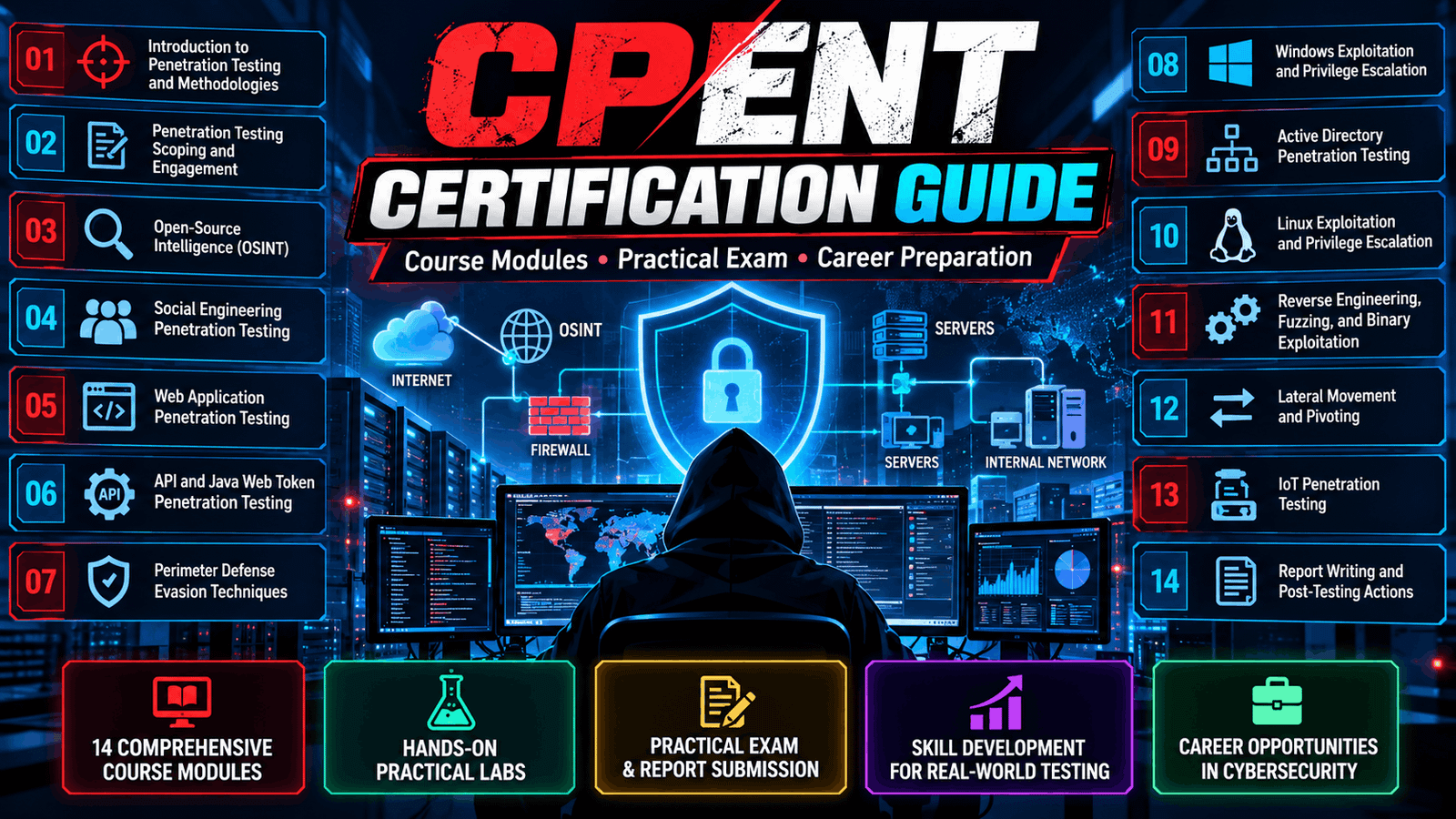
The official course outline includes the following 14 modules:
- Introduction to Penetration Testing and Methodologies
- Penetration Testing Scoping and Engagement
- Open-Source Intelligence (OSINT)
- Social Engineering Penetration Testing
- Web Application Penetration Testing
- API and Java Web Token Penetration Testing
- Perimeter Defense Evasion Techniques
- Windows Exploitation and Privilege Escalation
- Active Directory Penetration Testing
- Linux Exploitation and Privilege Escalation
- Reverse Engineering, Fuzzing, and Binary Exploitation
- Lateral Movement and Pivoting
- IoT Penetration Testing
- Report Writing and Post-Testing Actions
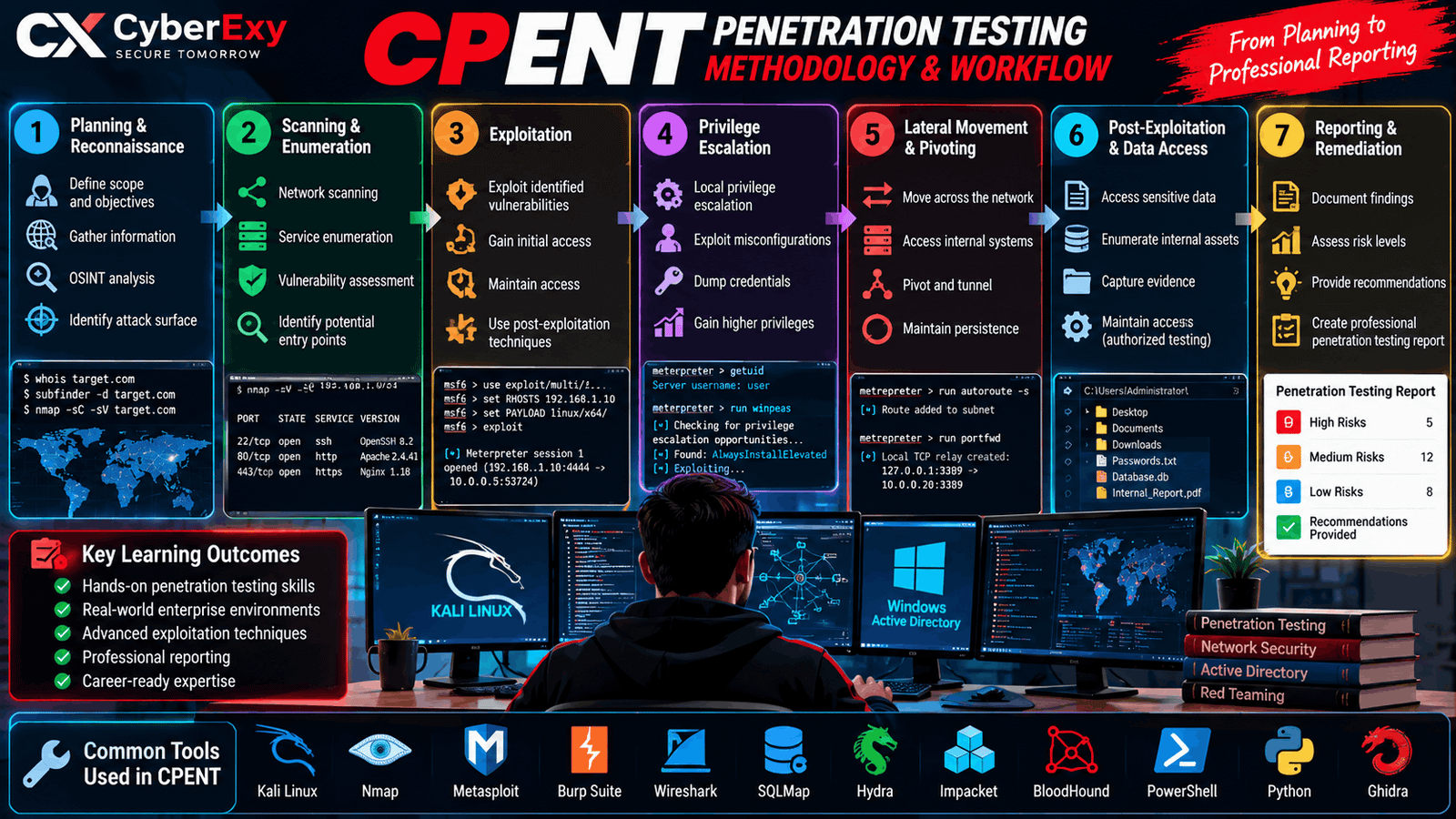
These modules cover a broad range of penetration-testing activities, from planning an authorised assessment to documenting findings and recommending remediation.
Key Skills Covered in CPENT
Network and Infrastructure Security
Learn how penetration testers assess network configurations, identify exposed services, evaluate defensive controls, and understand network segmentation.
Web Application and API Security
Explore web application assessment, authentication and authorisation weaknesses, input validation, session security, and common application vulnerabilities.
Windows, Linux and Active Directory
Understand enterprise identity systems, operating-system security, access controls, privilege management, and common configuration weaknesses.
OSINT and Attack-Surface Mapping
Study how publicly available information can help security professionals understand an organisation’s external attack surface.
Binary Analysis and IoT Security
Explore software analysis, reverse engineering concepts, firmware security, and methods for identifying weaknesses in specialised systems.
Professional Penetration-Testing Reports
Learn how to communicate findings clearly, explain risk, document evidence, and provide actionable recommendations to improve security.
CPENT Exam Format
According to EC-Council’s published programme information, the CPENT examination is practical and includes a penetration-testing report submission.
The official programme describes these exam arrangements:
- One 24-hour session or two 12-hour sessions.
- A proctored examination.
- A penetration-testing report submitted within seven days of the final session.
- A minimum score of 70% to earn CPENT.
- A score above 90% may qualify a candidate for the Licensed Penetration Tester (LPT) credential, subject to applicable requirements.
Always verify current examination policies, pricing, eligibility, and scheduling directly with EC-Council before registering.
How to Prepare for CPENT
A structured preparation plan can help learners build the required foundation.
Step 1: Strengthen networking fundamentals. Understand TCP/IP, DNS, routing, common protocols, firewalls, and network troubleshooting.
Step 2: Practise Linux and Windows administration. Learn permissions, services, processes, logs, authentication, and system configuration.
Step 3: Study web and API security. Review common application vulnerabilities, authentication mechanisms, access control, and secure development principles.
Step 4: Build scripting skills. Use Python, Bash, or PowerShell to automate appropriate security-testing and analysis tasks.
Step 5: Practise in authorised environments. Use your own lab, intentionally vulnerable applications, or training ranges where you have explicit permission to conduct security testing.
Step 6: Develop reporting skills. Practise writing clear findings with evidence, risk ratings, business impact, and remediation recommendations.
Career Opportunities After CPENT
The knowledge covered by CPENT may support preparation for roles such as:
- Penetration Tester
- Security Analyst
- Vulnerability Assessment Analyst
- Application Security Analyst
- Red-Team Security Professional
- Cybersecurity Consultant
Career outcomes depend on practical experience, technical knowledge, communication skills, and employer requirements. Certification alone does not guarantee employment.
Is CPENT Worth Considering?
CPENT may be worth considering for learners who already have a foundation in networking, operating systems, and cybersecurity and want to develop more advanced practical assessment skills.
Before enrolling, compare the curriculum, training costs, examination requirements, and hands-on practice available. Also consider whether the certification matches your intended career path.

Official CPENT Resources
- EC-Council CPENT programme: https://www.eccouncil.org/train-certify/certified-penetration-testing-professional-cpent/
- EC-Council iClass course information: https://iclass.eccouncil.org/our-courses/certified-penetration-testing-professional-cpent/
Conclusion
The EC-Council CPENT certification provides structured training across advanced penetration-testing topics, including network security, web applications, enterprise systems, binary analysis, IoT, and professional reporting.
For learners aiming to progress in cybersecurity, combining structured study with consistent practice in authorised lab environments can help develop practical skills and a stronger professional portfolio.