Cisco Free Ethical Hacker Course: 70 Hours & 34 Labs

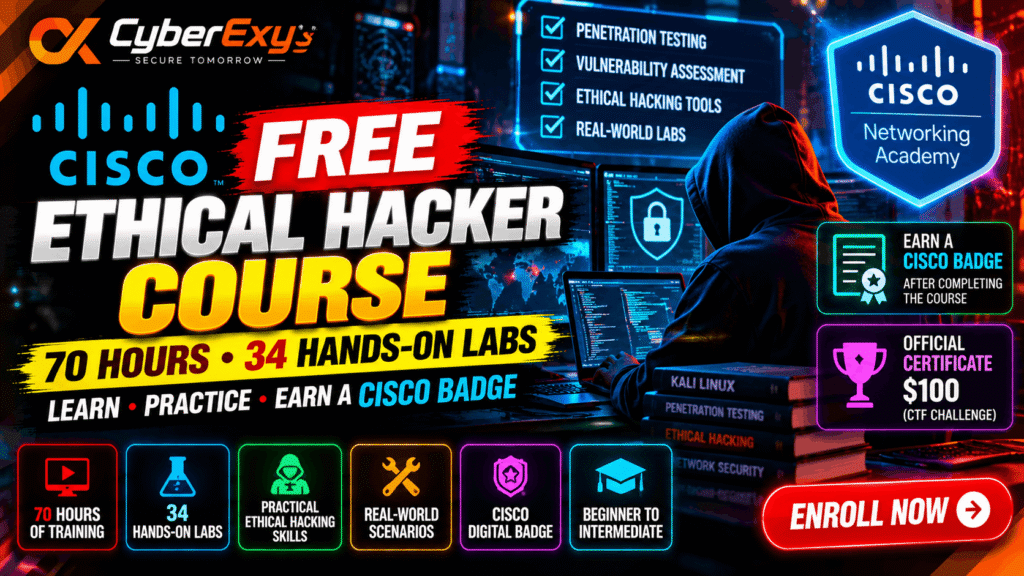
Cisco Offers a Free Ethical Hacker Course: 70 Hours of Training and 34 Hands-On Labs
Introduction
Want to develop practical ethical hacking skills without paying for a training course? Cisco Networking Academy offers an Ethical Hacker course at no cost, providing learners with an opportunity to explore offensive security, vulnerability assessment and penetration testing fundamentals.
The course is listed as an intermediate-level programme with an estimated duration of 70 hours. It includes 34 hands-on labs, interactive practice activities and a final assessment. Learners who successfully complete the course requirements can earn a Cisco-validated digital badge.
For students, aspiring cybersecurity professionals and IT learners, this is a useful opportunity to build foundational offensive security knowledge through structured training from a recognised technology provider.
Course details at a glance
- Provider: Cisco Networking Academy
- Course: Ethical Hacker
- Estimated duration: 70 hours
- Hands-on labs: 34
- Course price: Free
- Difficulty: Intermediate
- Learning format: Self-paced and instructor-led options
- Recognition: Ethical Hacker digital badge, subject to course requirements
You can review the official course and enrol through Cisco Networking Academy.
What Is Cisco’s Ethical Hacker Course?
Cisco’s Ethical Hacker course introduces learners to the methods cybersecurity professionals use to identify weaknesses in computer systems, networks and applications before malicious actors can exploit them.
Ethical hacking involves authorised security testing. Rather than attacking systems without permission, ethical hackers work within an agreed scope to discover vulnerabilities, document their findings and recommend improvements.
The course uses a practical, scenario-based learning approach to help students understand how offensive security techniques contribute to stronger cybersecurity.
It is designed for learners with some existing cybersecurity knowledge, so beginners may benefit from reviewing networking, operating systems and basic programming concepts before starting.
What Will You Learn in the 70-Hour Course?
The course focuses on skills that are relevant to vulnerability assessment and entry-level offensive security work.
1. Ethical Hacking Fundamentals
Understand the purpose of ethical hacking, the importance of authorisation and the responsibilities involved in conducting security assessments. Learn why testing must follow defined rules, scope and legal requirements.
2. Information Gathering and Vulnerability Assessment
Explore how security professionals collect relevant information about authorised targets and identify potential weaknesses. Learn how to assess findings and determine which vulnerabilities may require further investigation.
3. Network and Application Security
Study common security weaknesses affecting networks and applications. The course introduces offensive security concepts that help learners understand how vulnerabilities arise and how organisations can reduce their exposure.
4. Penetration Testing Tools and Techniques
Develop familiarity with security testing tools and workflows used in practical cybersecurity environments. Cisco’s course materials include hands-on activities involving tools such as Kali Linux.
5. Reporting and Mitigation
Finding a vulnerability is only part of the job. Security professionals must also document their observations, explain potential risks and recommend appropriate mitigation measures.
The course helps learners understand the importance of communicating assessment results clearly and professionally.
Why Are the 34 Hands-On Labs Important?
Practical exercises allow learners to apply concepts rather than relying exclusively on written explanations.
Cisco describes the course as including 34 labs and additional interactive practice activities. These exercises are designed around realistic cybersecurity scenarios to reinforce the learning experience.
Hands-on practice can help learners:
- Understand vulnerability assessment workflows.
- Become familiar with penetration testing environments.
- Connect theoretical concepts with practical tasks.
- Improve technical problem-solving skills.
- Develop a foundation for further offensive security training.
Always perform security testing within the authorised environments provided by the course or on systems for which you have explicit permission.
Is Cisco’s Ethical Hacker Course Completely Free?
Yes, the Ethical Hacker training course itself is free. However, the course and the separate Cisco Certificate in Ethical Hacking are not the same thing.
Cisco describes a two-step pathway for the separate certificate:
Step 1: Complete the free course.
Study the Ethical Hacker curriculum and pass the required course assessment. Successful learners can earn the course’s digital badge under the applicable criteria.
Step 2: Complete a paid Capture the Flag challenge.
To earn the separate Cisco Certificate in Ethical Hacking, learners must also pass at least one qualifying Capture the Flag (CTF) challenge through Cisco U. Cisco lists the challenge at US$100.
Therefore, you do not need to pay US$100 simply to access the free course. The fee relates to the separate CTF challenge required for the additional certificate.
Check Cisco’s official programme information for current pricing, eligibility and assessment requirements before registering for the paid component.
What Is the Difference Between the Course Badge and the Certificate?
The distinction matters when updating a CV, LinkedIn profile or professional portfolio.
Ethical Hacker course badge: Recognises successful completion of the Cisco Networking Academy course and its required assessment.
Cisco Certificate in Ethical Hacking: A separate credential requiring completion of the free course and successful completion of a qualifying CTF challenge.
Both can help communicate learning achievements, but they represent different requirements. List the exact credential you have earned rather than describing the course badge as the separate certificate.
You can check the official Cisco Ethical Hacker badge information on Credly and Cisco’s certificate programme guide.
Who Should Consider This Course?
This course may be useful for:
- Cybersecurity students who want to strengthen their practical knowledge.
- IT support and networking learners interested in security roles.
- Aspiring penetration testers building a foundation in offensive security.
- Junior security analysts who want to understand how attackers identify weaknesses.
- Self-directed learners looking for structured training without an upfront course fee.
Although the course is free, it requires a meaningful time commitment. Plan your study sessions, complete the labs carefully and review any concepts you find difficult.
How to Enrol in Cisco’s Free Ethical Hacker Course
Follow these steps to get started:
- Open the official Cisco Networking Academy Ethical Hacker course page.
- Review the course description, estimated duration and learning requirements.
- Sign in or create an account if prompted.
- Follow the available enrolment instructions.
- Work through the learning modules and practical activities.
- Complete the required course assessment and check your badge eligibility.
Course availability, enrolment options and requirements may change, so use Cisco’s official page for the latest details.
Can This Course Help Your Cybersecurity Career?
Completing structured training can demonstrate initiative and help you build knowledge relevant to cybersecurity roles. However, a course badge alone does not guarantee employment or establish professional-level penetration testing ability.
For stronger career preparation, combine the course with networking fundamentals, Linux practice, scripting, additional authorised labs and well-documented projects. Learn to explain not only how a vulnerability is identified, but also how its impact is assessed and how it can be mitigated.
You can also build a portfolio of lab reports that explains the objective, authorised environment, methodology, findings and recommended remediation for each exercise. Do not publish confidential information or details from systems you do not have permission to test.
Final Thoughts
Cisco Networking Academy’s free Ethical Hacker course offers a structured way to explore offensive security through approximately 70 hours of training and 34 hands-on labs. It is worth considering for learners who want to improve their understanding of vulnerability assessment, penetration testing workflows and security reporting.
Remember the key distinction: the course is free, while the separate Cisco Certificate in Ethical Hacking requires a paid CTF challenge listed at US$100. Review the official requirements before making any payment.

CyberExy — Secure Tomorrow. Follow us for more cybersecurity learning resources, practical guidance and technology updates.