
Digital Forensics for Pentesters: Practical Investigations

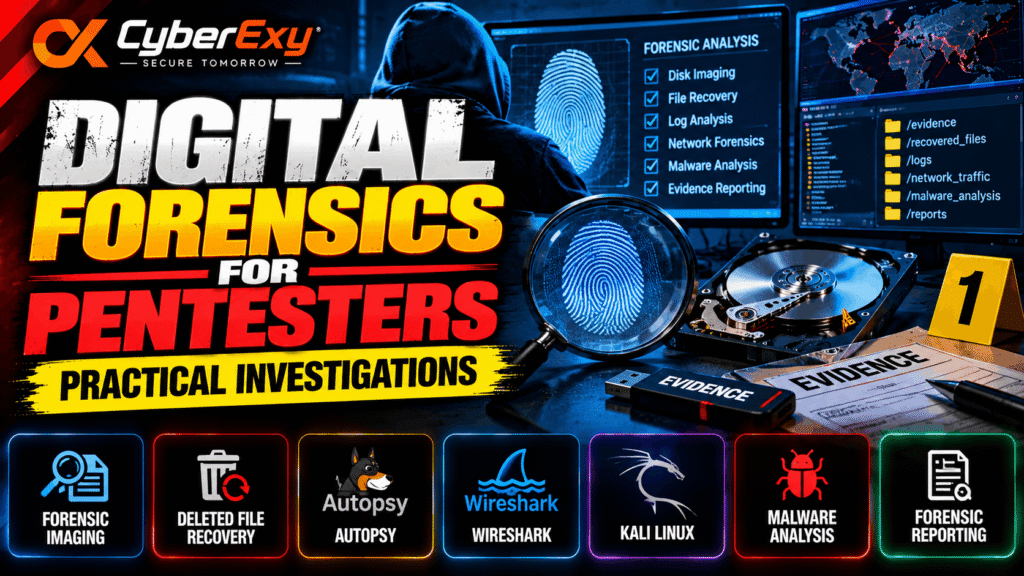
Digital Forensics for Pentesters: A Practical Guide to Cyber Investigations
Introduction
Penetration testing helps organisations identify security weaknesses before attackers can exploit them. However, discovering a vulnerability is only one part of cybersecurity. Understanding what happened during an incident, identifying traces of malicious activity and preserving digital evidence are equally important.
Digital forensics for pentesters combines security testing knowledge with investigative techniques to help cybersecurity professionals examine systems, analyse suspicious activity and understand potential compromises.
Practical training in this area can help aspiring penetration testers, security analysts and digital forensic investigators develop skills that extend beyond vulnerability discovery.
What Is Digital Forensics for Penetration Testers?
Digital forensics is the systematic process of identifying, collecting, preserving and analysing digital evidence. In penetration testing and incident response, these techniques can help explain how an event occurred, what systems were affected and which indicators require further investigation.
For example, after an authorised security assessment, an investigator may examine system logs, file metadata, network traffic and application activity to understand the sequence of events.
The objective is to produce reliable findings supported by evidence rather than assumptions.
Essential Skills Covered in Practical Investigations
1. Forensic Imaging and Evidence Collection
Forensic imaging creates a bit-for-bit copy of a storage device for examination. Working from an appropriate forensic image helps investigators preserve the original evidence and reduce the risk of accidental modification.
Hash values can be used to verify the integrity of evidence files. Proper documentation should record how evidence was acquired, who handled it and what procedures were followed.
2. Deleted-File Recovery
Deleting a file does not always remove every trace of its contents. Depending on the storage medium and subsequent activity, forensic tools may recover deleted files or identify remnants that help explain previous system activity.
These techniques can support investigations into accidental data loss, suspicious file activity and potential security incidents.
3. Digital Forensic Tools
Tools such as Autopsy support the examination of disk images and file-system artefacts. Wireshark helps investigators inspect network traffic, while Kali Linux provides a specialised environment for various security and forensic tasks.
Other tools may support evidence management, malware analysis and investigation workflows. Their suitability depends on the evidence available and the objectives of the case.
4. Malware Analysis and Reverse Engineering
Examining suspicious software can help investigators understand its behaviour, identify indicators of compromise and determine how it interacts with a system.
Reverse engineering can provide insight into a program’s functionality without relying solely on its appearance or stated purpose. Analysis should take place in an isolated, controlled environment.
5. Reporting and Evidence Integrity
A professional forensic report should explain the investigation’s scope, methodology, findings, limitations and conclusions. It should distinguish observed facts from interpretations and document the evidence supporting important claims.
Maintaining a clear chain of custody is particularly important when evidence may be used in legal or formal disciplinary proceedings.
Why Should Pentesters Learn Digital Forensics?
Combining penetration testing with forensic knowledge provides a broader understanding of security incidents. Pentesters can better understand system artefacts, recognise evidence of compromise and communicate findings in ways that support remediation.
These skills are also relevant to incident response, threat hunting, security operations and malware investigations. Practical exercises can help learners connect theoretical knowledge with structured investigative workflows.
How to Get Started
Begin by building foundational knowledge of networking, Linux and Windows systems. Set up an isolated virtual lab, practise examining sample forensic images and learn to document each investigation carefully.
The course Digital Forensics for Pentesters: Practical Investigations is a relevant learning resource for exploring forensic imaging, evidence handling, deleted-file recovery and investigative tools.

Conclusion
Digital forensics gives penetration testers an investigative perspective that complements technical security testing. By learning evidence preservation, file recovery, network analysis and professional reporting, cybersecurity learners can develop a more complete understanding of security incidents.
The key is to practise in authorised environments, preserve evidence carefully and base conclusions on verifiable findings.