
Fully Funded Scholarships in America 2027 for International Students

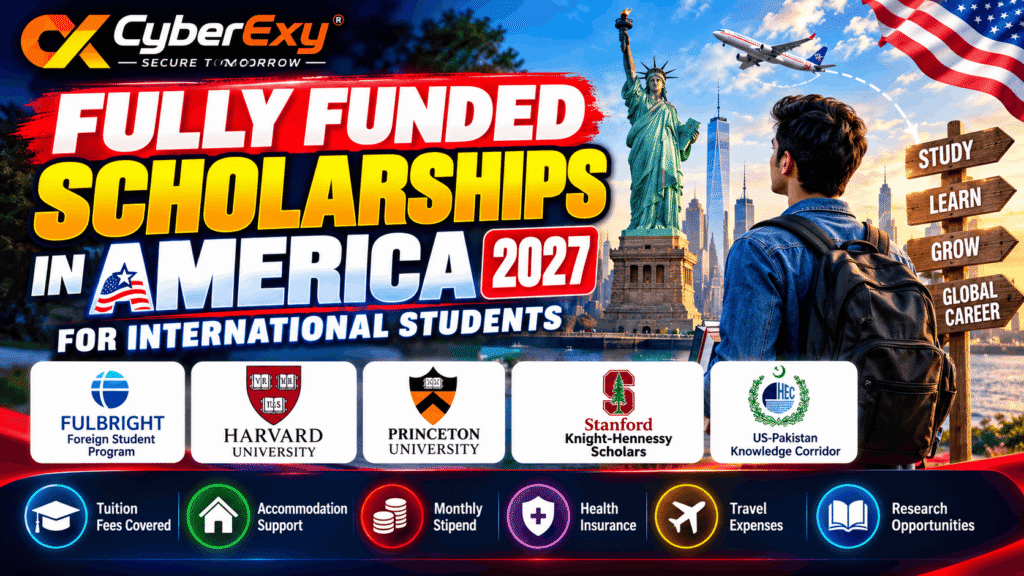
Fully Funded Scholarships in America for International Students 2027: Complete Guide
Planning to study in the United States in 2027 but worried about tuition fees, accommodation, and living expenses? The good news is that international students can apply for several scholarship programmes and university financial aid opportunities that may cover some or all of these costs.
The United States offers funding through government-sponsored exchange programmes, university financial aid, graduate scholarships, and country-specific initiatives. Some opportunities support master’s and PhD students, while others help undergraduate students complete a bachelor’s degree.
However, not every scholarship covers every expense, and receiving funding is never guaranteed. The key is to identify programmes that match your education level, nationality, academic background, and financial circumstances.
In this guide, you will learn about major scholarships in America for 2027, their eligibility requirements, what they may cover, how to apply, and where to find official information.
Important: Scholarship deadlines and eligibility requirements can change. This article was prepared in October 2026. Always confirm the latest requirements on the official programme website before applying.
Quick Overview: Scholarships in America for 2027
Here are some important funding opportunities to research.
| Scholarship or funding programme | Suitable for | Main funding route |
|---|---|---|
| Fulbright Foreign Student Program | Eligible international graduate students and researchers, depending on the country programme | Government-sponsored educational exchange |
| Harvard University Financial Aid | Undergraduate applicants with demonstrated financial need | University-funded need-based aid |
| Princeton University Financial Aid | Undergraduate applicants with demonstrated financial need | University-funded need-based aid |
| Knight-Hennessy Scholars | Eligible graduate applicants to Stanford University | Graduate scholarship and leadership programme |
| US-Pakistan Knowledge Corridor | Eligible Pakistani applicants pursuing PhD studies | Government-supported doctoral scholarship |
| Other US university scholarships | Undergraduate and graduate students, depending on the institution | Merit awards, need-based aid, assistantships, or fellowships |
These opportunities are not interchangeable. For example, the Fulbright Foreign Student Program is not the same as Harvard’s financial aid programme, and Knight-Hennessy Scholars is intended for graduate-level study rather than a general undergraduate scholarship.
1. What Is a Fully Funded Scholarship?
A fully funded scholarship is an award designed to cover the major expenses associated with studying at a university. The exact benefits depend on the scholarship provider.
A comprehensive funding package may include:
- Tuition fees: The cost of your academic programme.
- Accommodation: University housing or an approved housing allowance, where included.
- Living allowance: Money to help pay for food, transport, and other everyday expenses.
- Health insurance: Medical insurance or an approved health benefit, if included in the award.
- Travel expenses: International airfare or travel support, if provided.
- Books and academic materials: Funding for required learning resources, where applicable.
- Research expenses: Support for eligible research activities in some graduate programmes.
Not every scholarship includes all these benefits. Some cover tuition only, while others provide a package based on the student’s financial need or the programme’s funding rules.
Before applying, read the official funding description and determine which expenses are covered, which are excluded, and whether the award is renewable each academic year.
Fully funded scholarships vs. full tuition scholarships
These terms have different meanings.
Fully funded scholarship: May cover tuition and additional expenses such as living costs, accommodation, insurance, and travel.
Full tuition scholarship: Covers tuition fees but may leave the student responsible for accommodation, food, transport, insurance, and other expenses.
Need-based financial aid: Financial assistance calculated using the student’s or family’s financial circumstances.
Merit-based scholarship: An award based on criteria such as academic performance, leadership, talent, research achievement, or other accomplishments.
Understanding these differences will help you avoid accepting an offer that appears fully funded but leaves major costs unpaid.
2. Fulbright Foreign Student Program
The Fulbright Foreign Student Program is one of the best-known international educational exchange programmes associated with studying in the United States. It supports eligible students and scholars through participating country programmes.
Depending on the country and the specific award, the programme may support graduate study, research, or other approved academic activities.
Who can apply?
Eligibility varies by country. Applicants may need to meet requirements relating to:
- Citizenship or nationality.
- Previous academic qualifications.
- Academic performance.
- English-language ability.
- Intended field of study.
- Research interests or professional experience.
- Programme-specific selection criteria.
Some programmes support master’s degrees, PhD study, or research, while others have different structures. Do not assume that the same rules apply to every nationality.
What does Fulbright cover?
Funding depends on the applicable country programme and award conditions. A package may include approved tuition costs, living support, health-related benefits, and travel expenses.
Applicants should confirm the exact benefits, duration, eligible institutions, and any conditions directly with the organisation administering the scholarship.
How do you apply?
- Visit the official Fulbright Foreign Student Program website.
- Find the participating programme for your country.
- Read the eligibility criteria and application instructions.
- Prepare the required academic records and application documents.
- Complete the application before the country-specific deadline.
- Follow the official selection process, including any interviews or assessments.
Official website: https://foreign.fulbrightonline.org/
For Pakistani applicants: Review the relevant programme information from the United States Educational Foundation in Pakistan (USEFP): https://www.usefp.org/
Is Fulbright open for 2027?
Application dates differ by country and competition cycle. Some application periods for the 2027–2028 academic cycle may already have closed, so check the current announcement rather than relying on a general deadline.
3. Harvard University Financial Aid for International Students
Harvard University is a major option for students seeking undergraduate education with substantial financial assistance.
Harvard offers need-based financial aid to eligible international undergraduate students. Its published policy states that international students are eligible for the same financial aid as US students, and Harvard meets 100% of demonstrated financial need for admitted students who qualify.
This is an important distinction: Harvard’s undergraduate support is primarily based on financial need rather than a traditional merit scholarship awarded simply for having the highest grades.
Who should consider applying?
Harvard may be worth researching if you:
- Are preparing to apply for an undergraduate degree.
- Have a strong academic record.
- Can demonstrate intellectual curiosity and engagement beyond the classroom.
- Meet the university’s admission requirements.
- Need financial assistance to attend.
- Can provide the financial information required for aid assessment.
Excellent grades can strengthen an application, but no particular grade or achievement guarantees admission.
What expenses may be covered?
Harvard calculates financial aid according to a student’s demonstrated financial need and the university’s applicable cost-of-attendance rules.
Depending on the individual award, assistance may contribute to expenses such as:
- Tuition.
- Housing.
- Food.
- Other eligible education-related costs.
The amount varies according to the student’s assessed circumstances. A student should review the current aid policy and award details instead of assuming that every applicant receives the same package.
How to apply
- Review Harvard’s undergraduate admission requirements.
- Prepare your academic transcript and other required application materials.
- Check the application deadline for your intended entry year.
- Submit the required financial aid forms and supporting documentation.
- Respond promptly to any requests for additional information.
- Review your admission decision and financial aid offer carefully.
Official financial aid website: https://college.harvard.edu/financial-aid/how-aid-works
Important: Admission and financial aid decisions are separate parts of a competitive process. Applying for aid does not guarantee admission or a particular funding amount.
4. Princeton University Financial Aid for International Students
Princeton University is another institution international undergraduate applicants should research.
Princeton states that it meets the full demonstrated financial need of admitted international undergraduate students. Its admission process is need-blind, meaning an applicant’s financial need does not disadvantage them in the undergraduate admission decision.
Princeton’s aid programme is need-based rather than a conventional academic or athletic merit scholarship programme.
What does Princeton financial aid cover?
The university assesses a family’s financial circumstances and calculates the support an admitted student needs.
Depending on the student’s award, financial assistance may cover costs associated with:
- Tuition.
- Housing.
- Meals.
- Books and supplies.
- Other eligible personal and educational expenses.
The actual award is individual. Students must submit the required financial information and follow Princeton’s current financial aid instructions.
Who can apply?
International students seeking an undergraduate degree may apply if they meet the university’s admission requirements. Applicants should demonstrate their academic preparation, interests, achievements, and suitability for the programme.
There is no universal GPA that guarantees admission. Students should review Princeton’s current academic, testing, English-language, and application requirements.
How to apply
- Visit Princeton’s undergraduate admission website.
- Review the requirements for international applicants.
- Prepare your academic records, essays, and recommendations.
- Submit the admission application by the applicable deadline.
- Complete the required financial aid application.
- Check your application portal and respond to any additional requests.
Official international applicant information: https://admission.princeton.edu/apply/international-students
Official cost and financial aid information: https://admission.princeton.edu/cost-aid
Is Princeton a fully funded scholarship?
Princeton does not operate its undergraduate support in exactly the same way as a single, fixed-value scholarship. Instead, it assesses demonstrated financial need and provides qualifying admitted students with financial aid designed to meet that need.
For students with significant financial need, the resulting package may cover most or all of the calculated cost of attendance. The university determines the individual award.
5. Knight-Hennessy Scholars at Stanford University
The Knight-Hennessy Scholars programme at Stanford University supports eligible graduate students and focuses on leadership, independent thinking, and positive contributions to society.
It is designed for graduate-level study, not as a general scholarship for students starting a bachelor’s degree.
Who should consider Knight-Hennessy Scholars?
This programme may be relevant if you:
- Have completed or expect to complete a bachelor’s degree within the applicable eligibility period.
- Plan to apply to an eligible full-time Stanford graduate degree programme.
- Can demonstrate leadership, initiative, and a commitment to making a positive contribution.
- Meet the programme’s current application requirements.
- Are prepared to submit both the scholarship and degree-programme applications when required.
Eligibility depends on the rules for the relevant cohort. Applicants should check the official requirements rather than assuming that every graduate programme or applicant qualifies.
What funding is available?
The programme’s published scholarship benefits can include support for tuition and associated academic fees, a living stipend, and travel support, subject to the programme’s terms and duration.
Applicants should confirm the current award structure, eligible expenses, and any conditions on the official website.
How to apply
- Identify a Stanford graduate degree programme that matches your goals.
- Review that programme’s admission requirements.
- Read the Knight-Hennessy Scholars eligibility rules.
- Prepare your academic records, résumé, essays, and recommendations.
- Submit the scholarship application and the required Stanford degree application.
- Follow the official selection timeline.
Official website: https://knight-hennessy.stanford.edu/
Is the 2027 application still open?
The Knight-Hennessy Scholars application for the 2027 cohort closed on 6 October 2026. As of this article’s October 2026 update, applicants who missed that deadline should check the official website for information about the next cycle.
The deadline for the Stanford graduate degree programme may be different from the scholarship deadline, so applicants should check both.
6. US-Pakistan Knowledge Corridor Scholarship
The US-Pakistan Knowledge Corridor is an important funding route for eligible Pakistani students interested in doctoral study in the United States.
The programme is associated with Pakistan’s Higher Education Commission (HEC) and aims to develop advanced academic and research capacity through PhD-level study at eligible US universities.
It is particularly relevant to Pakistani applicants who want to pursue doctoral research in areas that contribute to academic, scientific, technological, or national development.
Who can apply?
Applicants must satisfy the current HEC eligibility criteria. Depending on the applicable category and announcement, requirements may include:
- Pakistani or eligible AJK nationality.
- A qualifying undergraduate degree or equivalent formal education.
- Acceptable academic results.
- A valid GRE General or HAT score where required.
- Admission to an eligible US university or fulfilment of the relevant category’s admission requirements.
- Compliance with age limits and other conditions.
- Agreement to meet the programme’s obligations after completing the degree.
HEC’s published eligibility guidance includes different age limits for certain groups, including eligible public-sector employees and researchers. Applicants must verify the precise requirements applicable to their category and the relevant application deadline.
What does the scholarship cover?
Funding depends on the applicable scholarship category and current HEC rules. The programme may provide tuition support and a living stipend for eligible doctoral students.
Do not rely on an old stipend figure or university ranking category without checking the latest official announcement. Funding limits, eligible universities, and selection conditions can change.
How to apply
- Visit the official HEC scholarship portal.
- Read the latest US-Pakistan Knowledge Corridor announcement.
- Confirm that you meet the education, age, test-score, and other eligibility requirements.
- Research eligible US universities and doctoral programmes.
- Prepare the required documents and admission evidence.
- Complete the online application according to HEC’s instructions.
- Monitor official announcements and respond to requests for additional documents.
HEC scholarship portal: https://scholarship.hec.gov.pk/
Official eligibility information: https://www.hec.gov.pk/english/scholarshipsgrants/US-Pakcorridor/Pages/Eligibility-Criteria.aspx
Official application guidance: https://www.hec.gov.pk/english/scholarshipsgrants/US-Pakcorridor/Pages/How-to-Apply.aspx
Does the Knowledge Corridor fund master’s degrees?
The US-Pakistan Knowledge Corridor PhD scholarship route described by HEC focuses on doctoral study. Students seeking a standalone master’s degree should investigate other HEC programmes, Fulbright opportunities, university scholarships, and graduate funding options.
Always check the latest programme notice for the exact degree levels and study pathways it supports.
7. Other Universities Offering Financial Aid and Scholarships
The universities above are useful starting points, but they are not the only places to research.
Different American universities offer different combinations of need-based financial aid, merit scholarships, graduate fellowships, research assistantships, and teaching assistantships.
Yale University
Yale offers need-based financial aid to eligible undergraduate students, including international applicants. Review its current international applicant and financial aid policies to understand the application process and funding assessment.
Official website: https://admissions.yale.edu/
Massachusetts Institute of Technology (MIT)
MIT offers need-based financial aid to eligible undergraduate students, including international students. Students interested in MIT should distinguish undergraduate financial aid from graduate funding, because graduate departments and programmes may use different funding arrangements.
Official website: https://mitadmissions.org/
University of Michigan
The University of Michigan offers various financial aid and scholarship opportunities, but eligibility for international students varies by award and programme. Do not assume that all university aid is available to non-US citizens.
Official website: https://admissions.umich.edu/
Clark University
Clark University has offered scholarship opportunities for international students, including awards associated with undergraduate admission. Applicants should review the current scholarship names, eligibility rules, award values, and deadlines.
Official website: https://www.clarku.edu/
Ohio Wesleyan University
Ohio Wesleyan University offers funding opportunities that may be relevant to international applicants. Check its current international admission and scholarship information to determine which awards are available for your entry year.
Official website: https://www.owu.edu/
A useful rule: A university’s reputation does not tell you whether it will provide enough financial aid for your situation. Check the official international student policy, the scholarship’s eligibility rules, and the estimated remaining cost after funding.
8. How to Find the Right Scholarship for Your Education Level
Before completing applications, decide what type of study you want to pursue.
If you want a bachelor’s degree
Focus on undergraduate universities that offer financial aid to international students. Harvard and Princeton are examples of institutions with published need-based aid policies for international undergraduates.
Prepare your school transcripts, application essays, recommendations, and any required testing or English-language documentation.
If you want a master’s degree
Research country-specific Fulbright opportunities, university scholarships, and graduate programmes with dedicated funding.
Check whether the funding supports the specific master’s degree you want. Some scholarships are restricted to certain subjects, universities, or nationalities.
If you want a PhD
Look at Fulbright opportunities where eligible, university doctoral funding, research assistantships, teaching assistantships, and programmes such as Knight-Hennessy Scholars where you meet the requirements.
Pakistani applicants should also investigate the US-Pakistan Knowledge Corridor and its current eligibility conditions.
If you are a Pakistani student
Start by checking:
- USEFP for relevant Fulbright programme announcements.
- HEC for the US-Pakistan Knowledge Corridor and other eligible funding schemes.
- Official university websites for international student financial aid.
- Graduate department websites for PhD funding, research positions, and assistantships.
Do not assume that a scholarship available to one nationality or degree level is automatically available to everyone.
9. Eligibility Requirements for US Scholarships in 2027
Every scholarship has its own criteria, but the following requirements are common across many programmes.
Academic qualifications
You may need a secondary school certificate, bachelor’s degree, master’s degree, or another qualification depending on the programme.
Your academic record should demonstrate that you are prepared for the course you intend to study. Some programmes have minimum grade or degree requirements, while others assess the full application.
English-language proficiency
Some universities require evidence of English-language ability through tests such as IELTS Academic, TOEFL iBT, or other accepted assessments.
However, requirements differ by institution and programme. Some universities waive tests in particular circumstances, and some programmes accept alternative evidence. Check the exact policy before paying for a test.
Standardised tests
Depending on the university and programme, applicants may need SAT, ACT, GRE, GMAT, or other test scores.
These tests are not universally required. Verify the requirements for your specific course and entry year before registering for an examination.
Financial documentation
Need-based financial aid applications may require details about family income, assets, household circumstances, and other financial information.
You may need to provide official documents or explanations where standard records are unavailable. Submit truthful and consistent information and follow the university’s instructions for international applicants.
Essays and personal statements
Many applications ask you to explain your academic interests, personal experiences, future goals, and reasons for choosing a particular university or field.
A strong essay should be specific and honest. Explain what you want to learn, why the programme fits your plans, and what experiences have prepared you for it.
Recommendation letters
Some scholarships require teachers, professors, employers, or supervisors to recommend you.
Choose people who know your work well enough to provide specific examples of your academic ability, initiative, reliability, or leadership. Give them enough time to complete the recommendation.
10. Step-by-Step Guide to Applying for Fully Funded Scholarships in America
A clear application plan can help you manage multiple deadlines without missing important documents.
Step 1: Choose your degree and subject
Decide whether you want to pursue a bachelor’s, master’s, or PhD degree.
Then narrow your choices to a subject area. For example, you might be interested in computer science, cybersecurity, business, engineering, public health, education, or social sciences.
Your subject choice affects which universities, scholarships, and funding arrangements are suitable.
Step 2: Build a shortlist of universities
Research universities that offer your chosen degree and accept international applicants.
For each university, record:
- Degree name.
- Admission requirements.
- International student eligibility.
- Available scholarships and financial aid.
- Required application forms.
- Application deadlines.
- Estimated tuition and living expenses.
Do not apply solely because a university appears in a scholarship list. Make sure it offers the right programme and an appropriate funding route.
Step 3: Confirm scholarship eligibility
Read the official rules for each award.
Ask yourself:
- Does the scholarship accept applicants from my country?
- Does it fund my intended degree level?
- Is my subject eligible?
- Do I meet the academic requirements?
- Are test scores required?
- Does the programme require university admission first?
- Are there age, work-experience, or return-service conditions?
- Is the deadline still open?
If any requirement is unclear, contact the scholarship provider or university through its official contact channel.
Step 4: Prepare your academic documents
Depending on the programme, you may need:
- Academic transcripts.
- Degree certificates or school-leaving certificates.
- A CV or résumé.
- A statement of purpose or personal essays.
- Letters of recommendation.
- English-language test results.
- Standardised test results, where required.
- Research proposals for relevant research programmes.
- Passport or citizenship documents.
- Financial aid forms and supporting evidence.
Prepare clear, accurate copies and follow the official instructions for translations, certification, and submission.
Step 5: Write a strong personal statement
Your personal statement should connect your background, interests, and future plans.
A simple structure is:
- Explain your academic interest.
- Describe relevant experiences or achievements.
- Explain why the selected programme fits your goals.
- Identify the skills or knowledge you hope to develop.
- Describe how you plan to use your education.
Avoid vague claims such as “I want to study at the best university.” Instead, explain why the particular course, research area, or academic environment is right for you.
Never invent achievements or copy another applicant’s essay.
Step 6: Request recommendation letters early
Ask your recommenders well before the deadline. Give them the scholarship description, your CV, and information about your goals so they can write a relevant recommendation.
Check whether each programme requires recommendations from teachers, academic supervisors, employers, or other individuals.
Step 7: Submit the university and scholarship applications
Some scholarships use a separate application, while others assess applicants through the university admission process.
You may need to submit two applications: one for admission and another for funding.
Complete every required section, upload the correct documents, and verify that your application has been submitted successfully. An incomplete application may not be considered.
Step 8: Track deadlines and application status
Use a calendar or spreadsheet to track each deadline, document, test, recommendation, and application status.
Keep confirmation emails and copies of submitted forms. Check your email and application portal regularly for requests from universities or scholarship providers.
Step 9: Review your offer carefully
If you receive an offer, read the funding letter rather than relying on the scholarship’s name.
Confirm:
- Total tuition covered.
- Living stipend and payment schedule.
- Housing arrangements.
- Health insurance.
- Travel support.
- Award duration.
- Renewal requirements.
- Any costs you must pay yourself.
- Any service, return, or other contractual obligations.
If the offer does not cover all your expenses, calculate the remaining amount before accepting it.
Step 10: Prepare for the student visa process
After receiving the required admission and immigration documents, follow the official US student visa instructions.
Visa procedures depend on the type of study and the documents issued by the institution. You may need to demonstrate that you meet the applicable visa requirements, including financial documentation.
A scholarship does not automatically guarantee a visa. Follow the current official instructions and avoid making non-refundable travel arrangements before you understand the applicable requirements.
Official US student visa information: https://travel.state.gov/content/travel/en/us-visas/study/student-visa.html
11. How to Increase Your Chances of Winning a Scholarship
Scholarships can be competitive, especially when they cover most or all educational expenses. You cannot guarantee selection, but you can improve the quality of your application.
Apply to suitable programmes
Choose scholarships that match your nationality, academic background, intended degree, and subject.
An excellent application for an unsuitable programme is unlikely to be successful.
Demonstrate academic preparation
Present your grades, relevant coursework, research, projects, and other achievements accurately.
If your academic record has weaknesses, focus on providing context where permitted and demonstrating your readiness for the programme.
Explain your goals clearly
Show how the degree connects to your future plans. Scholarship committees need to understand why the opportunity fits your interests and how you intend to use the education.
Highlight meaningful experience
Relevant experience may include research, volunteering, community involvement, personal projects, internships, employment, or leadership roles.
You do not need to claim that every activity changed the world. Explain what you actually did, what you learned, and why it matters.
Submit a complete application
Follow the instructions carefully. Missing documents, incorrect forms, inconsistent information, and late submissions can undermine an otherwise strong application.
Apply to more than one suitable opportunity
Build a balanced shortlist rather than depending on one university or scholarship. Include different institutions and funding routes, while ensuring that each application meets the programme’s requirements.
12. Scholarship Deadlines for the 2027 Academic Year
There is no single deadline for all fully funded scholarships in America. Each scholarship and university sets its own application schedule.
Some applications for 2027 entry may close during 2026, while others may have later deadlines or separate application cycles.
Use this approach:
| Programme | What to check |
|---|---|
| Fulbright Foreign Student Program | Your country’s application period and the relevant award cycle |
| Harvard undergraduate admission and financial aid | The deadline for your intended entry year and all required financial aid forms |
| Princeton undergraduate admission and financial aid | The applicable admission deadline and financial aid submission requirements |
| Knight-Hennessy Scholars | The next scholarship cycle and the separate Stanford degree deadline |
| US-Pakistan Knowledge Corridor | The latest HEC announcement, category requirements, and submission deadline |
| Other university scholarships | The award’s eligibility, deadline, renewal rules, and funding coverage |
Do not rely on old blog posts for deadlines. If an application date has passed, check whether the programme has announced its next cycle rather than submitting an outdated application.
13. Can International Students Work While Studying in America?
Some international students in F-1 status may be permitted to work on campus, subject to immigration rules and any applicable requirements.
Under standard rules, eligible F-1 students may generally work up to 20 hours per week on campus while school is in session, with different arrangements during qualifying breaks.
Off-campus work is subject to separate restrictions and may require specific authorisation. Students should not assume that they can work in any job or rely on future employment to pay tuition.
Scholarship applicants should prepare a realistic budget before travelling. A part-time job is not a substitute for meeting the financial requirements of a study programme or visa application.
Official guidance: https://www.ice.gov/sevis/employment
14. Common Mistakes to Avoid When Applying
Students can lose time or miss opportunities by making avoidable mistakes.
Mistake 1: Assuming every scholarship is fully funded. Check whether the award covers tuition only or also pays living and other expenses.
Mistake 2: Applying without checking nationality requirements. Some scholarships are open to applicants worldwide, while others are restricted to citizens of particular countries.
Mistake 3: Ignoring the degree level. A scholarship for graduate study may not accept undergraduate applicants.
Mistake 4: Missing the deadline. Record the correct date and time zone, and submit early where possible.
Mistake 5: Paying for unnecessary tests or services. Confirm whether a test, credential evaluation, consultant, or other service is actually required.
Mistake 6: Using unverified scholarship websites. Start with the official university, government, or programme website. Be cautious of anyone promising guaranteed admission or guaranteed scholarship approval in exchange for a fee.
Mistake 7: Submitting inaccurate information. Academic records, financial details, employment history, and other application information should be truthful and consistent.
Mistake 8: Forgetting living expenses. Even a tuition scholarship can leave substantial costs uncovered.
Mistake 9: Assuming admission guarantees a scholarship. Admission and funding may involve different eligibility criteria and selection decisions.
Mistake 10: Relying on outdated information. Verify deadlines, funding values, and requirements for the exact application cycle.
15. Frequently Asked Questions About Fully Funded Scholarships in America 2027
1. Can international students study in America for free?
Yes, some international students may receive financial aid or scholarship packages that cover the full calculated cost of attendance. However, eligibility is competitive, and not every university or programme provides full funding.
2. Which US universities offer full financial aid to international students?
Harvard and Princeton publish policies stating that they meet the full demonstrated financial need of admitted international undergraduate students who qualify. Their aid is assessed individually and is not a guarantee of admission.
Other universities have different policies, so verify international eligibility before applying.
3. Are fully funded scholarships available for bachelor’s degrees?
Yes. Some US universities provide substantial need-based financial aid or competitive scholarships for undergraduate students. Harvard and Princeton are examples of institutions with need-based aid policies for international undergraduates.
4. Are fully funded master’s scholarships available in the USA?
Some programmes support eligible master’s students, but availability depends on the scholarship, country, university, and subject. Investigate Fulbright country programmes and university-specific funding options.
5. Can I get a fully funded PhD in America?
Yes. Some doctoral programmes provide funding through fellowships, research assistantships, teaching assistantships, scholarships, or a combination of these arrangements.
Read the funding offer carefully to understand its duration, stipend, tuition coverage, work expectations, and renewal conditions.
6. Can Pakistani students apply for US scholarships in 2027?
Pakistani students can research relevant Fulbright opportunities, HEC programmes, university financial aid, and eligible graduate scholarships. Each programme has its own rules, so check nationality requirements, academic qualifications, deadlines, and degree-level restrictions.
7. Is the US-Pakistan Knowledge Corridor for bachelor’s or master’s degrees?
The PhD scholarship route described by HEC is intended for doctoral study. Applicants looking for bachelor’s or master’s funding should check other HEC schemes, Fulbright opportunities, and university funding programmes.
8. Do I need IELTS or TOEFL for a US scholarship?
It depends on the university and scholarship. Some require an accepted English-language test, while others may waive it or accept alternatives under specific conditions. Check the requirements of both the university and the scholarship provider.
9. Do I need the SAT or GRE?
Not always. SAT or ACT requirements vary across undergraduate institutions, and GRE requirements vary across graduate programmes. Some scholarship programmes also have their own testing rules.
Check the current requirements before registering for an exam.
10. Can I apply without work experience?
Some undergraduate and graduate scholarships do not require professional work experience. Others, including certain fellowship programmes, may require relevant experience or particular professional qualifications.
Read the specific eligibility criteria.
11. Does a scholarship cover accommodation and food?
Some packages include housing and living support, while others cover tuition only or provide a different combination of benefits. Check the official award terms before accepting an offer.
12. Can I apply for several scholarships at the same time?
You can generally apply to multiple suitable programmes, provided you meet their rules. However, some awards restrict combining funding or receiving another scholarship simultaneously. Disclose other awards when required and read each programme’s conditions.
13. Do I need an admission offer before applying for a scholarship?
It depends on the programme. Some scholarships require admission to an eligible university before funding is awarded, while others allow you to submit scholarship and admission applications separately or simultaneously.
14. Are scholarships available for students with average grades?
Possibly. Requirements differ, and some programmes assess academic results alongside other factors. Nevertheless, competitive scholarships may expect strong academic preparation. Focus on opportunities for which you meet the published eligibility criteria.
15. Can a scholarship guarantee a US student visa?
No. A scholarship award does not guarantee a visa. Applicants must meet the applicable immigration requirements and follow the official visa process.
16. Are scholarship applications free?
Some university and scholarship applications have no application fee, while others charge fees or offer fee waivers to eligible applicants. Check the official instructions for each programme. Never assume that all applications are free.
17. Where can I find genuine scholarship announcements?
Begin with official government scholarship portals, university admission and financial aid websites, and the official programme websites linked in this article. Confirm the announcement date and application cycle before submitting personal documents.
16. Official Scholarship Websites and Useful Resources
Use these official sources to verify eligibility, application procedures, and deadlines.
- Fulbright Foreign Student Program: https://foreign.fulbrightonline.org/
- United States Educational Foundation in Pakistan (USEFP): https://www.usefp.org/
- Harvard University Financial Aid: https://college.harvard.edu/financial-aid/how-aid-works
- Princeton University International Applicants: https://admission.princeton.edu/apply/international-students
- Princeton University Cost and Financial Aid: https://admission.princeton.edu/cost-aid
- Knight-Hennessy Scholars at Stanford University: https://knight-hennessy.stanford.edu/
- HEC US-Pakistan Knowledge Corridor: https://scholarship.hec.gov.pk/
- HEC Knowledge Corridor Eligibility Criteria: https://www.hec.gov.pk/english/scholarshipsgrants/US-Pakcorridor/Pages/Eligibility-Criteria.aspx
- EducationUSA: https://educationusa.state.gov/
- US Department of State Student Visa Information: https://travel.state.gov/content/travel/en/us-visas/study/student-visa.html
Always use the official source for the final decision about eligibility, application deadlines, required documents, and scholarship coverage.
Final Thoughts: Start Preparing for US Scholarships in 2027
Studying in America can be expensive, but eligible international students have several routes to explore financial support. Government-sponsored programmes, university need-based aid, graduate scholarships, and country-specific initiatives may help make an American education more affordable.
Start by deciding which degree you want to pursue. Then identify universities and scholarship programmes that accept applicants from your country, check their current requirements, and prepare your documents well before the deadlines.
If you are applying from Pakistan, investigate USEFP and HEC opportunities alongside university-specific funding. If you are applying for undergraduate study, pay particular attention to universities with published international financial aid policies. If you are pursuing graduate study, research fellowships, assistantships, and scholarships designed for your degree level.
Most importantly, verify every opportunity through its official website, understand exactly what the funding covers, and never assume that a scholarship or visa is guaranteed. Careful research and a well-prepared application will help you make better decisions about your educational future.
Editorial note: Scholarship availability, deadlines, award amounts, eligibility, and visa rules may change. Confirm the latest official information before applying.