Fake Web3 Accelerator Spreads Malware Through npm Packages Copy title

Fake Web3 Accelerator Uses Malicious npm Packages to Steal Data and Hijack AI Traffic
Cybercriminals are increasingly exploiting trust in artificial intelligence (AI) tools and Web3 investment opportunities to distribute malware. A campaign tracked as REF8801 demonstrates how seemingly legitimate developer tools can become a gateway to data theft, backdoors, and compromised AI workflows.
According to Elastic Security Labs, the operation impersonated a Web3 venture capital accelerator called Apex Accelerator. It attracted cryptocurrency startups and developers with offers of free AI credits, coding assistance, investment opportunities, and smart-contract security audits.
Malicious npm Packages Disguised as Developer Tools
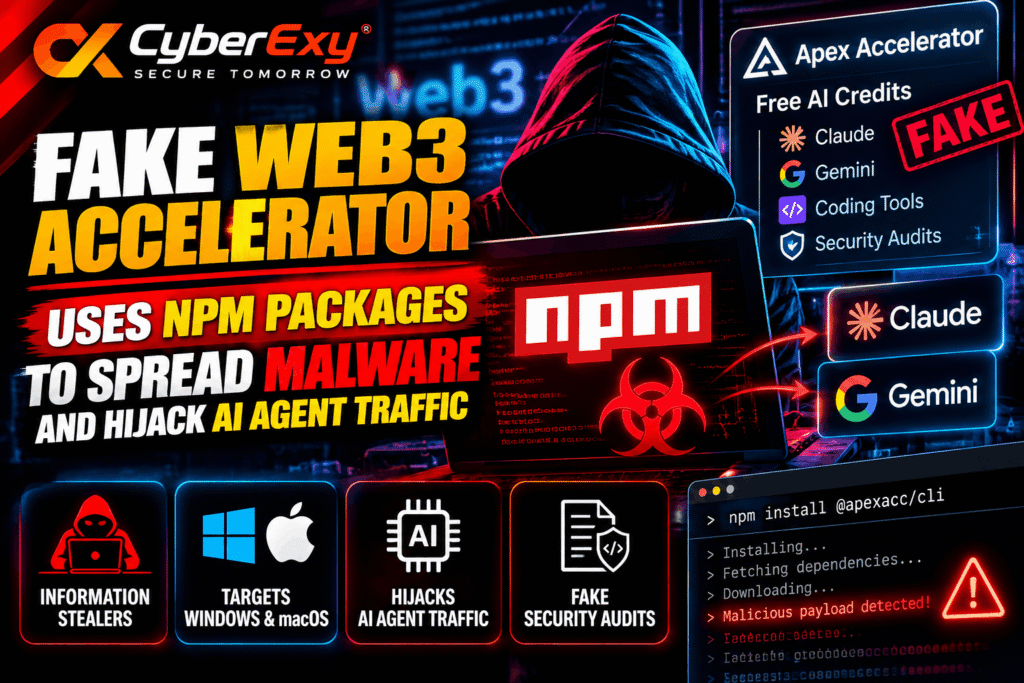
Researchers identified two npm packages: @apexacc/cli, promoted as an AI advisor for Web3 founders, and @apexacc/audit, advertised as a collection of 18 security tools. Both packages promised useful functionality but were found to participate in a malicious operation.
The audit package generated fabricated security findings instead of performing the advertised checks. This is particularly concerning because developers might trust convincing reports when evaluating cryptocurrency projects, wallets, or smart contracts.
The campaign also used its apparent industry presence and investment promises to manufacture credibility. This highlights why a professional website, conference presence, or attractive product description should never replace independent verification.

Malware Targets Windows and macOS
The packages were associated with different malicious payloads for Windows and macOS systems. Researchers linked the Windows infection chain to a custom information stealer and the macOS chain to a backdoor known as CloudSyncD.
The Windows malware was reported to collect sensitive information, including browser data, clipboard contents, system details, and cryptocurrency-related information. Stolen data could be transmitted through Telegram.
On macOS, the operation used scripts and a deceptive password prompt to help launch malicious components. The incident reinforces that both operating systems can be targeted by software supply-chain attacks.

AI Coding Agents Become Another Attack Surface
One of the campaign’s most significant features involved AI traffic interception. The malicious coding tool redirected model requests through attacker-controlled infrastructure rather than the expected service.
This could expose prompts, conversation history, code snippets, and tool outputs sent by the coding agent. The operation also registered a remote Model Context Protocol (MCP) server, creating another potential channel for attacker-controlled instructions and tools.
For developers, this means that installing an AI coding assistant can introduce risks beyond traditional malware. An untrusted integration may affect both local data and the confidentiality of information submitted to AI services.
How Developers Can Reduce the Risk
Developers and cryptocurrency teams should take several precautions:
- Verify package publishers: Check package history, repository ownership, maintainers, and independent security reports before installation.
- Treat free offers cautiously: Unexpected AI credits, investment proposals, or audit tools should be verified through independently confirmed channels.
- Review permissions: Limit access to sensitive files, credentials, wallets, and AI-agent tools.
- Protect secrets: Never provide seed phrases, private keys, or account passwords to unverified software.
- Monitor endpoints: Use reputable endpoint protection and investigate suspicious network connections or unexpected software changes.
- Validate audit results: Seek reproducible evidence and independent reviews instead of trusting scores generated by an unfamiliar tool.
Conclusion
The REF8801 campaign illustrates how social engineering, malicious npm packages, fabricated security reports, and compromised AI integrations can combine into one attack. The key lesson is simple: verify the software before trusting its promises.
For more cybersecurity insights and practical security guidance, follow CyberExy — Secure Tomorrow.
Source: Elastic Security Labs, “Auditing the auditor: Unmasking Apex Accelerator,” October 12, 2026.