AI Agent Email & WhatsApp Automation: Zero to Pro

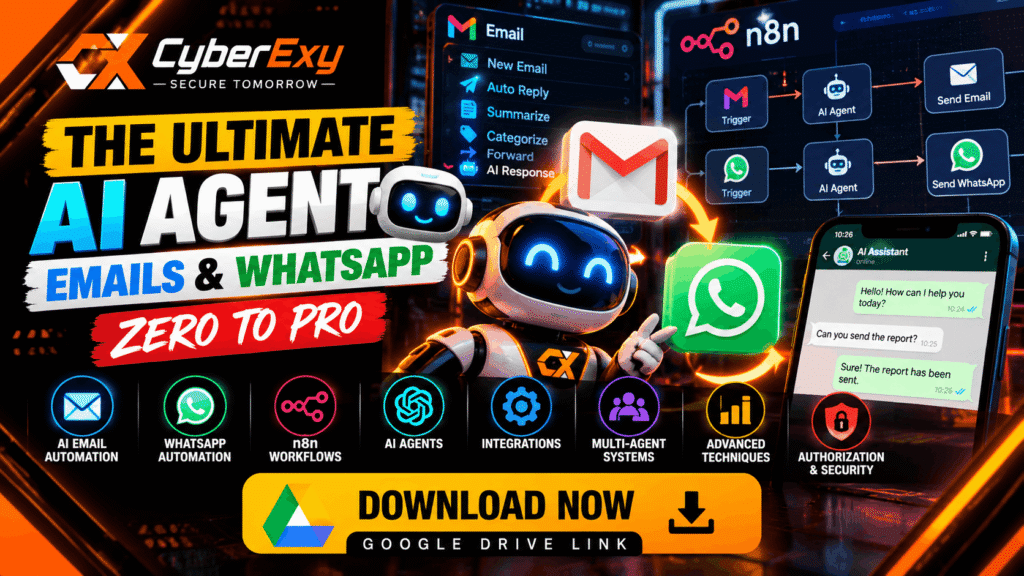
The Ultimate AI Agent: Emails and WhatsApp Automation from Zero to Pro
Introduction
Artificial intelligence is changing how businesses manage communication, customer support and everyday workflows. AI agents can help automate repetitive tasks, organise information, draft email responses and support customer interactions through messaging platforms.
For individuals and businesses looking to improve productivity, learning how to build AI agents for email and WhatsApp can be a valuable technical skill. With workflow automation platforms such as n8n, users can connect applications, configure triggers and create automated processes with limited manual intervention.
The Ultimate AI Agent Emails and WhatsApp: Zero to Pro is a learning resource for exploring these concepts, from introductory AI agent principles to advanced integrations and multi-agent workflows.
What Is an AI Agent?
An AI agent is a software system that can interpret information, make decisions within defined limits and perform tasks using connected tools. Unlike a basic automation that follows only fixed rules, an AI-powered workflow can use a language model to interpret messages, classify requests or generate context-aware responses.
For example, an email automation system might identify an incoming customer enquiry, summarise its contents, prepare a suggested reply and route the message to the appropriate team.
AI agents should operate with appropriate permissions, clear instructions and human approval for sensitive actions.
What You Can Learn from the Course
The resource folder is organised into multiple modules covering different stages of AI agent development.
1. AI Agent Fundamentals
Understand general AI agent concepts, workflow automation and the building blocks needed to create practical AI-powered systems.
2. High-Level AI Agent Workflows
Explore how AI agents process information, use connected tools and coordinate tasks within an automated workflow.
3. Introduction to n8n
Learn about n8n as a workflow automation platform for connecting applications, configuring triggers and building processes that combine AI services with other software.
4. Building an Email AI Agent
Explore how email workflows can help classify incoming messages, summarise enquiries, draft replies and route requests according to predefined conditions.
5. Authorisation and Permissions
Understand why secure authentication, access permissions and careful credential management are essential when connecting email accounts and external services.
6. Building an AI Agent Workflow
Learn how different workflow components can work together to process information, call AI models and automate selected tasks.
7. Advanced AI Agent Techniques
Explore more advanced automation concepts, including workflow branching, error handling, tool integration and improving reliability.
8. Integrating Email Services
Discover how email integrations can support communication workflows, notifications, message processing and business productivity.
9. Multi-Agent Systems and Automation
Explore how multiple AI agents can divide responsibilities and coordinate tasks. For example, one agent could classify customer messages while another prepares a response for human review.
The exact coverage and practical exercises depend on the materials available in the course folder.
How AI Agents Can Automate Email and WhatsApp
Email and WhatsApp are widely used for business communication, making them potential components of automated customer-service workflows.
Examples include:
- Email management: Categorising messages, summarising enquiries and drafting responses.
- Customer support: Preparing answers to frequently asked questions.
- Lead management: Organising enquiries and routing them to the appropriate team.
- Notifications: Sending approved updates when a workflow reaches a defined stage.
- WhatsApp communication: Supporting customer interactions through authorised integrations and approved messaging interfaces.
- Multi-agent workflows: Dividing complex tasks into smaller steps handled by specialised agents.
WhatsApp automation must follow the platform’s applicable policies, consent requirements and messaging rules. Businesses should avoid unsolicited bulk messages and provide appropriate ways for recipients to manage their communication preferences.
Best Practices for Secure AI Automation
Building a working AI agent is only one part of a successful implementation. Security, privacy and reliability are equally important.
Follow these recommendations:
- Use official integrations and authorised APIs.
- Apply least-privilege access to connected accounts.
- Store credentials securely and never expose API keys in public workflows.
- Require human approval before sending sensitive messages or performing consequential actions.
- Test workflows with dummy data before connecting live accounts.
- Monitor execution logs and configure error handling.
- Protect personal information and retain only the data necessary for the workflow.
These practices can help reduce operational errors and protect sensitive business information.
Access the AI Agent Course Resources
Ready to explore AI-powered email and WhatsApp automation?
Open the course folder here:
Review the available modules and choose a learning path that matches your current experience. Access depends on the Google Drive folder’s sharing permissions.
Conclusion
AI agents offer practical opportunities to improve email management, customer communication and repetitive business workflows. By combining AI models, n8n and authorised application integrations, learners can explore automation projects ranging from simple email assistants to more advanced multi-agent systems.
The key to successful implementation is to balance productivity with security, human oversight and responsible data handling.
Start with a simple workflow, test it carefully, and expand its capabilities as you gain experience