Top 10 Best Hardware Security Modules (HSMs) in 2026

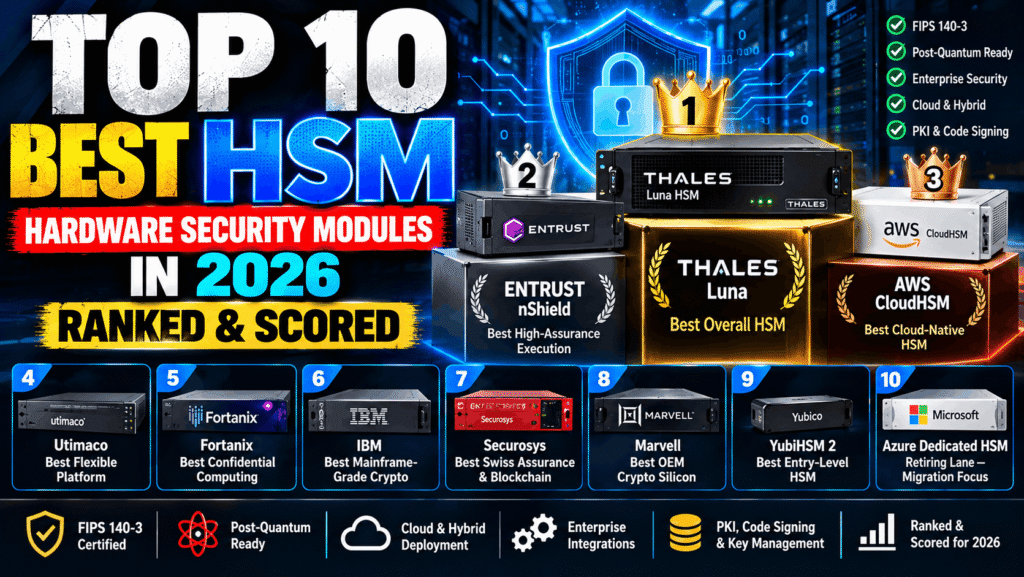
Top 10 Best Hardware Security Modules (HSMs) in 2026: Ranked and Scored
Introduction
Hardware Security Modules (HSMs) are essential components of modern cybersecurity infrastructure. They protect cryptographic keys, perform sensitive cryptographic operations, and establish trusted foundations for public key infrastructure (PKI), digital certificates, payment processing, code signing, and cloud security.
As organisations prepare for evolving cybersecurity requirements, two considerations are becoming increasingly important: compliance with current cryptographic security standards and readiness for post-quantum cryptography (PQC).
Choosing an HSM in 2026 requires more than comparing processing speed or hardware specifications. Businesses must consider certification status, deployment flexibility, integration capabilities, operational costs, and long-term cryptographic migration plans.
This guide ranks ten HSM solutions based on the supplied editorial evaluation, covering enterprise appliances, cloud-native services, confidential-computing platforms, specialist cryptographic hardware, and more affordable options.
Important: The scores below are research-based editorial assessments, not laboratory benchmark results or independent certification ratings. Validate current product availability, certification records, pricing, and vendor roadmaps before purchasing.
Key Takeaways
- Best overall: Thales Luna, with broad enterprise integration and hardware-based key protection.
- Best for high-assurance execution: Entrust nShield, particularly where sensitive code must execute within the HSM boundary.
- Best cloud-native option: AWS CloudHSM for organisations operating workloads on AWS.
- Best confidential-computing alternative: Fortanix, offering a different approach to key management and data security.
- Best entry-level hardware protection: Yubico YubiHSM for smaller deployments and selected internal PKI or code-signing workloads.
- Important purchasing priority: Confirm FIPS 140-3 status and obtain a documented post-quantum cryptography roadmap.
How We Ranked the Best HSMs in 2026
The supplied evaluation uses five weighted criteria to compare the ten solutions.
| Evaluation criterion | Weight |
|---|---|
| Security certifications | 25% |
| Post-quantum cryptography readiness | 25% |
| Deployment flexibility | 20% |
| Ecosystem and integrations | 20% |
| Pricing transparency | 10% |
The assessment considers certification information, product capabilities, firmware roadmaps, cloud and hybrid deployment models, integration with PKI and key-management systems, and pricing structures.
The ranking is intended to help buyers identify suitable products for different workloads. It should not be interpreted as proof that one product is universally more secure than another.
Top 10 Hardware Security Modules in 2026
| Rank | HSM solution | Editorial score | Best suited for |
|---|---|---|---|
| 1 | Thales Luna | 9.1/10 | General-purpose enterprise HSM |
| 2 | Entrust nShield | 8.9/10 | High-assurance cryptographic execution |
| 3 | AWS CloudHSM | 8.6/10 | AWS-based workloads |
| 4 | Utimaco | 8.5/10 | Customisable cryptographic platforms |
| 5 | Fortanix | 8.3/10 | Confidential computing and multi-cloud security |
| 6 | IBM | 8.2/10 | Mainframe and banking infrastructure |
| 7 | Securosys | 8.0/10 | Financial infrastructure and digital-asset custody |
| 8 | Marvell | 7.9/10 | OEM cryptographic hardware |
| 9 | Yubico YubiHSM | 7.8/10 | Smaller deployments and entry-level HSM use |
| 10 | Microsoft Azure Dedicated HSM | 7.0/10 | Existing deployments requiring migration planning |
Scores reflect the supplied editorial ranking. They are not independently measured product-performance scores.
1. Thales Luna – Best General-Purpose HSM

Thales Luna ranks first in this evaluation because of its broad applicability across enterprise cryptographic infrastructure. Its portfolio includes network-attached, PCIe, and USB-based HSM options, alongside cloud delivery through Data Protection on Demand.
The platform supports use cases such as PKI, digital signing, cryptographic key management, and database security. Partitioning capabilities can also help organisations separate cryptographic workloads and administrative responsibilities.
Key advantages
- Broad integration options for enterprise security systems.
- Flexible deployment across physical and cloud environments.
- Established use in key management and digital-signing architectures.
- A vendor roadmap to investigate for post-quantum migration.
Potential limitations: Premium pricing and the need to select the correct product configuration for a particular workload.
Best for: Enterprises seeking a general-purpose HSM platform for multiple cryptographic applications.
Official website: Thales Luna Network HSMs
2. Entrust nShield – Best for High-Assurance Cryptographic Execution

Entrust nShield is a strong candidate for organisations that require strict separation between application software and cryptographic operations.
Its portfolio includes nShield Connect, nShield Solo, and service-based options. The CodeSafe capability is particularly relevant where supported sensitive code needs to execute within the HSM’s security boundary.
The platform is relevant to certificate authorities, enterprise PKI, payment infrastructure, and other environments with demanding key-management requirements.
Key advantages
- CodeSafe for supported in-HSM code execution.
- Established PKI and payment-sector use cases.
- Centralised management through the Security World architecture.
- Options for different deployment environments.
Potential limitations: Premium economics and integration requirements that need careful planning.
Best for: Organisations that need strong protection for both cryptographic keys and supported cryptographic application logic.
Official website: Entrust HSM Solutions
3. AWS CloudHSM – Best Cloud-Native HSM

AWS CloudHSM provides dedicated HSM instances within Amazon Web Services. It allows organisations to deploy hardware-backed cryptographic services without purchasing and maintaining their own physical HSM appliances.
The service is relevant to applications that require customer-controlled cryptographic operations, including selected payment, certificate-management, and enterprise encryption workloads.
Key advantages
- Cloud-based provisioning and infrastructure management.
- Clustering options for supported deployments.
- Hourly pricing model.
- Integration possibilities with AWS-based applications and selected key-management architectures.
Potential limitations: Strong dependence on the AWS environment and additional architectural considerations for hybrid deployments.
Best for: Organisations that need dedicated HSM capabilities for applications hosted on AWS.
Official website: AWS CloudHSM
4. Utimaco – Best Flexible Cryptographic Platform

Utimaco provides HSM solutions for enterprise cryptography, regulated industries, and original equipment manufacturer (OEM) deployments.
Its portfolio is relevant to specialised environments that need configurable cryptographic functionality. Depending on the product, software development capabilities and firmware options can support specific operational or regulatory requirements.
Key advantages
- Flexible deployment possibilities.
- Support for specialised and regulated workloads.
- OEM and industry-specific applications.
- A vendor roadmap worth evaluating for post-quantum cryptography.
Potential limitations: Buyers should confirm the exact firmware, certification, and integration requirements for their intended use case.
Best for: Organisations requiring configurable cryptographic infrastructure for specialised applications.
Official website: Utimaco
5. Fortanix – Best Confidential-Computing Alternative

Fortanix takes a different approach to data security by combining key management with confidential-computing technologies and secure execution environments.
Its Data Security Manager platform is relevant to organisations seeking centralised control over cryptographic keys and related security functions across different environments.
However, confidential computing and a traditional certified HSM are not interchangeable in every regulatory or technical context. Buyers should verify whether a specific Fortanix deployment satisfies their hardware security, certification, and compliance requirements.
Key advantages
- Cloud-oriented security management.
- Multi-environment key-management capabilities.
- Confidential-computing integration.
- Support for related data-protection use cases.
Potential limitations: Organisations with strict requirements for a particular HSM certification must evaluate the exact deployment and underlying hardware.
Best for: Businesses exploring confidential computing and centralised data-security management.
Official website: Fortanix Data Security Manager
6. IBM – Best for Mainframe and Banking Infrastructure

IBM provides specialised cryptographic hardware and services for enterprise environments, including IBM Z and LinuxONE systems.
Its Crypto Express portfolio is relevant to financial institutions and organisations operating workloads that depend on mainframe security, high-assurance cryptographic operations, and established enterprise infrastructure.
IBM also offers security-related capabilities for cloud environments, depending on the selected product and architecture.
Key advantages
- Integration with IBM mainframe environments.
- Enterprise cryptographic capabilities.
- Relevance to banking and other high-assurance workloads.
- Established cryptographic management options.
Potential limitations: The strongest fit is often within an existing IBM infrastructure estate.
Best for: Financial institutions and enterprises operating IBM Z or LinuxONE systems.
Official website: IBM PCIe Cryptographic Coprocessor
7. Securosys – Best for Digital-Asset Custody and Financial Infrastructure

Securosys provides HSM solutions for financial services, enterprise cryptography, and digital-asset applications.
Its Primus portfolio is relevant to environments that require controlled cryptographic operations. Digital-asset custody can additionally require transaction-authorisation policies, multi-party controls, and approval processes that prevent a single compromised account from authorising sensitive operations.
Key advantages
- Financial-services applications.
- Digital-asset and transaction-signing use cases.
- Options for hardware and cloud-based deployments.
- Support for specialised cryptographic architectures.
Potential limitations: Buyers should compare the available integrations and operational features with those of larger enterprise ecosystems.
Best for: Organisations managing sensitive financial cryptography or digital-asset custody infrastructure.
Official website: Securosys
8. Marvell – Best for OEM Cryptographic Hardware

Marvell’s LiquidSecurity technology targets OEMs, cloud providers, and service providers that incorporate cryptographic hardware into larger infrastructure platforms.
Unlike a conventional enterprise HSM appliance, an OEM-oriented solution may be integrated into a provider’s own hardware and service architecture. This makes the underlying technology important to infrastructure architects, even when end customers purchase a managed service rather than the hardware directly.
Key advantages
- Cryptographic hardware designed for infrastructure integration.
- Relevance to cloud and service-provider environments.
- Potential for high-density cryptographic deployments.
- OEM integration possibilities.
Potential limitations: It is not necessarily a direct substitute for a turnkey enterprise HSM purchase.
Best for: Infrastructure providers and technology companies building cryptographic services.
Official website: Marvell Hardware Security Modules
9. Yubico YubiHSM – Best Entry-Level Hardware HSM

YubiHSM 2 offers compact hardware-based key protection for selected cryptographic workloads. Its USB form factor can make it attractive to smaller organisations that need a hardware root of trust without the cost and operational complexity of a large HSM appliance.
Potential use cases include internal certificate authorities, code-signing keys, and selected SSH certificate-authority deployments.
Key advantages
- Compact hardware form factor.
- A comparatively accessible entry point into hardware-backed key protection.
- Suitability for selected small-scale workloads.
- Straightforward deployment for supported applications.
Potential limitations: Performance, interfaces, and feature capabilities differ from those of larger enterprise and payment-focused HSM platforms.
Best for: Small businesses, laboratories, development teams, and organisations protecting secondary cryptographic roots.
Official website: Yubico
10. Microsoft Azure Dedicated HSM – Existing Customers Should Plan Ahead

Microsoft Azure Dedicated HSM is included primarily for organisations that already use the service and need to assess their long-term infrastructure plans.
The supplied evaluation describes the service as being on a retirement path, with newer Azure HSM offerings identified as potential migration destinations.
For existing customers, the priority is to verify Microsoft’s current retirement dates, understand the migration requirements, and establish a tested transition plan for cryptographic keys and dependent applications.
Key advantages
- Relevance to existing Azure deployments.
- Dedicated HSM architecture for supported workloads.
- An established deployment model for current users.
Potential limitations: The reported retirement status makes it unsuitable as a default choice for most new purchasing decisions without a verified lifecycle review.
Best for: Existing customers evaluating migration and continuity planning.
Official starting point: Microsoft
Verify the current service status and official migration guidance before making operational decisions.
HSM Comparison: Features and Deployment Models
The following table summarises the broad positioning of the ten products. Exact certification and algorithm support must be confirmed for the specific model, firmware, service, and configuration.
| Solution | Deployment model | Pricing approach | Main strength |
|---|---|---|---|
| Thales Luna | Appliance and cloud options | Typically quotation-based | General-purpose cryptography |
| Entrust nShield | Appliance and service options | Typically quotation-based | High-assurance execution |
| AWS CloudHSM | AWS cloud | Hourly service pricing | Cloud-native deployment |
| Utimaco | Appliance and specialised platforms | Typically quotation-based | Configurable cryptography |
| Fortanix | SaaS and supported hardware options | Tiered or quotation-based | Confidential computing |
| IBM | PCIe, mainframe and selected cloud options | Typically quotation-based | Mainframe cryptography |
| Securosys | Appliance and cloud options | Product-dependent | Financial and digital-asset use cases |
| Marvell | OEM hardware | OEM pricing | Infrastructure integration |
| YubiHSM 2 | Compact USB hardware | Published pricing may be available | Smaller deployments |
| Azure Dedicated HSM | Existing Azure service | Service-dependent | Installed-base continuity |
What to Consider Before Buying an HSM in 2026
An HSM can remain part of an organisation’s security architecture for many years. Choosing one therefore requires evaluating both current requirements and long-term cryptographic changes.
1. Verify FIPS 140-3 Certification
Do not rely solely on a vendor’s general statement that a product is certified. Ask for the relevant certificate number, validation status, applicable hardware and firmware versions, and any transition dates that affect your compliance obligations.
A product family may contain multiple configurations with different certification statuses.
2. Evaluate Post-Quantum Cryptography Readiness
Post-quantum cryptography is becoming an important consideration for long-lived cryptographic infrastructure.
Ask vendors for a written roadmap covering the relevant NIST-standardised algorithms, including ML-KEM for key establishment and ML-DSA for digital signatures. Confirm which operations are supported, whether firmware upgrades are required, and whether additional costs apply.
A roadmap alone is not the same as current, production-ready algorithm support.
3. Match the HSM to Your Workload
Different applications require different capabilities.
- Enterprise PKI and general-purpose cryptography: Compare Thales Luna, Entrust nShield, and Utimaco.
- AWS-hosted workloads: Evaluate AWS CloudHSM and its fit with your existing architecture.
- Confidential computing: Consider Fortanix while verifying any mandatory HSM certification requirements.
- Mainframe cryptography: Evaluate IBM’s offerings.
- Digital-asset custody: Examine Securosys and the transaction-authorisation controls available.
- Smaller internal PKI deployments: Consider YubiHSM 2 where its capabilities meet the workload requirements.
These are starting points for evaluation rather than universal recommendations.
4. Rehearse Key Management and Recovery
Security depends on operational procedures as well as hardware.
Before deploying an HSM into production, rehearse key generation, backup, recovery, quorum approval, firmware updates, and disaster recovery. Ensure that authorised personnel can restore operations without compromising key protection.
5. Understand the Total Cost of Ownership
Purchase price is only one part of HSM costs. Include support, licensing, integration, cloud usage, redundancy, operational staffing, certification requirements, migration, and future cryptographic upgrades.
For cloud services, model expected utilisation and resilience requirements rather than comparing hourly prices in isolation.
Frequently Asked Questions
What is the best hardware security module in 2026?
In the supplied editorial ranking, Thales Luna takes first place for general-purpose HSM use. Entrust nShield is ranked highly for in-HSM execution, while AWS CloudHSM is recommended for AWS-centric workloads. The best choice depends on certification requirements, deployment architecture, budget, and intended use.
What is the difference between an HSM and a Key Management Service?
A Key Management Service (KMS) provides interfaces and controls for managing cryptographic keys throughout their lifecycle. An HSM is a hardware security boundary designed to protect keys and perform cryptographic operations. A KMS may use HSMs underneath its service architecture.
Is FIPS 140-3 important when selecting an HSM?
It can be essential where compliance requirements specify it. Organisations should verify the precise validation status and configuration applicable to their workloads instead of assuming that all products from a vendor share the same certification.
What does post-quantum readiness mean for an HSM?
It means the HSM has an appropriate, documented path for adopting post-quantum cryptographic algorithms. Buyers should distinguish between planned support, experimental support, and production-ready implementations.
Is Microsoft Azure Dedicated HSM being retired?
The supplied ranking describes the service as being on a retirement path. Existing customers should confirm the current status, official deadlines, and recommended migration options directly with Microsoft.
Are HSMs necessary for small businesses?
Not every small business requires a dedicated enterprise HSM. However, organisations protecting sensitive signing keys, certificate-authority roots, or other high-value cryptographic assets may benefit from a smaller hardware HSM where its capabilities match their requirements.
Final Verdict
The best HSM is the one that satisfies an organisation’s actual security, compliance, integration, and lifecycle requirements.
Thales Luna leads this supplied ranking for general-purpose enterprise use, Entrust nShield is a strong candidate for high-assurance cryptographic execution, and AWS CloudHSM offers a cloud-native deployment model. Fortanix, IBM, Securosys, Utimaco, Marvell, and YubiHSM address different specialist requirements.
Before committing to a long-term platform, verify current certifications, confirm post-quantum migration plans, evaluate the full cost of ownership, and test key recovery procedures. For existing Azure Dedicated HSM customers, confirm the official service lifecycle and plan any required migration early.
Editorial note: This ranking is based on the supplied research and weighted editorial criteria. The scores are not lab-tested results, independent certification ratings, or a guarantee of security. Product features, pricing, certification status, and service lifecycle information should be verified with the relevant vendors before purchase.