
Google Awards $250K for AI-Assisted Chrome Exploit

Google Awards $250,000 Bounty for AI-Assisted Chrome Exploit Using GPT-5.6 Sol
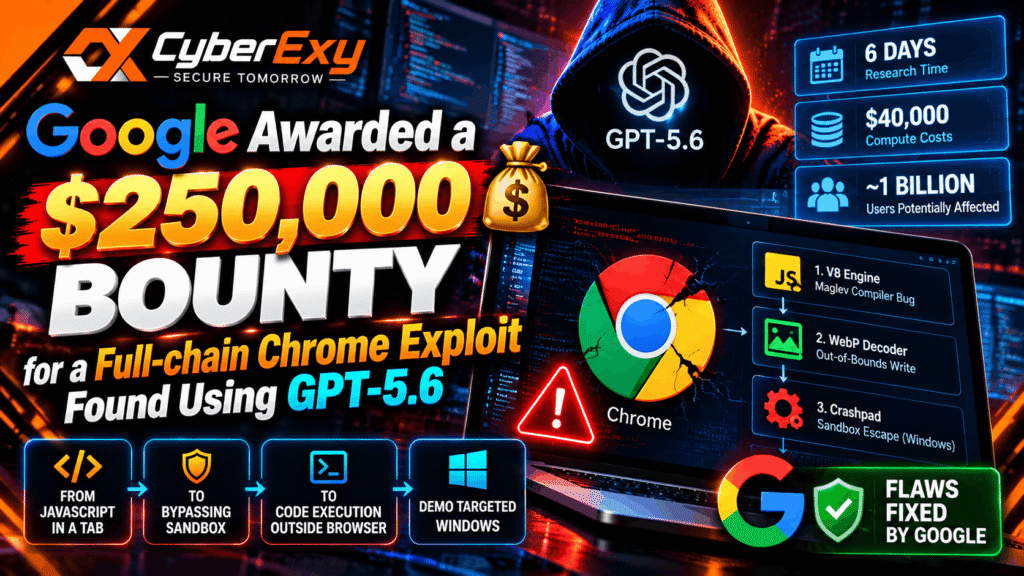
Google reportedly awarded XBOW a $250,000 bug bounty after its security researchers developed a full-chain Chrome exploit using AI agents powered by OpenAI’s GPT-5.6 Sol model. According to XBOW, the research took six days and approximately $40,000 in computing costs.
The disclosure, published on October 13, 2026, describes a chain of three vulnerabilities that demonstrated a path from JavaScript running in a Chrome tab to code execution outside the browser’s renderer sandbox. XBOW says Google has fixed all three flaws.
How the Chrome Exploit Worked
Chrome uses multiple security layers to isolate web content and limit the impact of compromised components. A full-chain exploit combines multiple vulnerabilities to cross these boundaries.
According to XBOW, its research involved three weaknesses:
- V8 JavaScript engine: A reported issue involving the Maglev compiler and deoptimisation could cause optimised code to make incorrect assumptions about JavaScript objects and memory.
- Animated WebP image decoder: Inconsistent handling of animation-frame information and image data reportedly caused an out-of-bounds write.
- Crashpad: A Windows-related issue in crash-reporting memory-read handling reportedly contributed to memory corruption outside the renderer sandbox.
Together, these weaknesses enabled the researchers to demonstrate a more serious security impact than any individual flaw might have achieved alone.
Why the $250,000 Bounty Matters
Google’s Chrome Vulnerability Reward Program recognises qualifying security research that demonstrates significant vulnerabilities in Chrome. XBOW says its submission met the requirements for a full-chain exploit reward.
The demonstration targeted Windows. The company estimated that the affected browser issue could have a potential reach of approximately one billion users, but this should not be interpreted as evidence that one billion devices were compromised.
The report describes a controlled security demonstration, not confirmed exploitation against real users.
How AI Agents Supported the Research
XBOW reported that its researchers used AI agents to investigate potential vulnerabilities, divide the work into smaller tasks and evaluate findings.
Human researchers guided the investigation, reviewed results and adapted the approach when an early exploit component was already known. According to the company, the final chain was developed between August 2 and August 7, 2026.
This case illustrates how AI may accelerate vulnerability research while highlighting the continued need for human validation, responsible disclosure and coordinated remediation.
What Chrome Users Should Do
Chrome users should install available security updates and relaunch the browser when prompted. Organisations should verify that updates reach managed devices and incorporate browser vulnerabilities into their vulnerability-management processes.
Developers should also review memory-safety controls, test interactions between software components and ensure that security boundaries do not rely on assumptions that can be invalidated by unexpected behaviour.
Conclusion
The reported $250,000 award highlights the potential of AI-assisted security research to identify and connect complex vulnerabilities. XBOW’s disclosure demonstrates why defenders must assess not only individual bugs but also how weaknesses across different components can combine.
AI can support faster security analysis, but reliable results still depend on technical verification, human oversight and timely patching.